
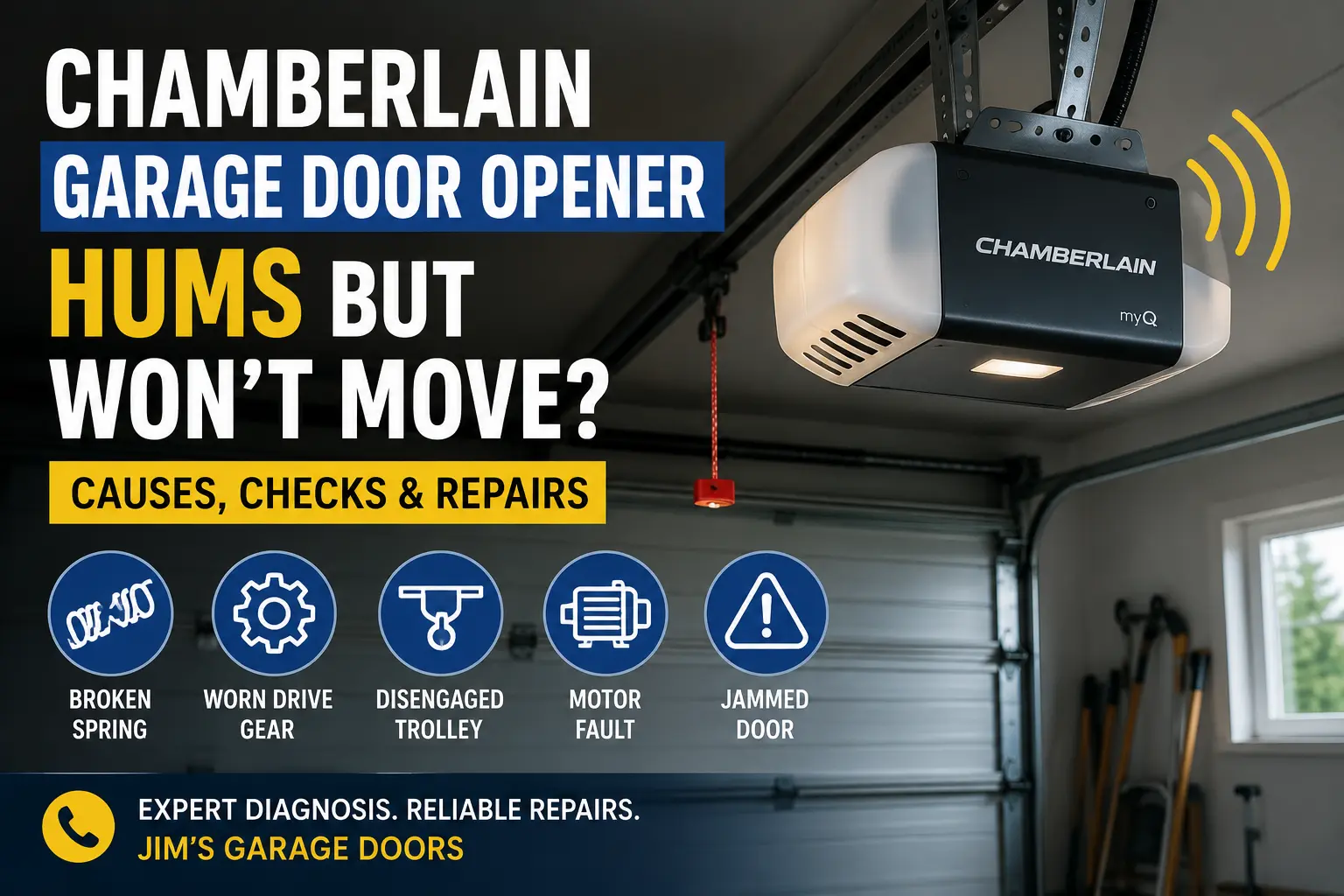
If your Chamberlain garage door opener hums but the garage door does not move, the motor is receiving power but cannot transfer enough force to open or close the door. The cause may be a broken spring, a disengaged trolley, a jammed garage door, a worn internal gear or a failed motor component.
Stop repeatedly pressing the remote until the cause is identified. Continued operation can overheat the motor, strip the drive gear or damage the opener rail.
Jim’s Garage Doors can inspect both the Chamberlain opener and the complete garage door system to identify the actual fault and recommend the most suitable repair.
📞 Call 131 546 or request a free quote online to book a professional Chamberlain garage door opener inspection today.
Why Does a Chamberlain Garage Door Opener Hum but Not Move?
A Chamberlain opener hums when the motor is energised but cannot rotate the drive system or move the garage door. This usually means the opener is overloaded, disconnected from the door or experiencing an internal mechanical or electrical fault.
The opener is not designed to lift the full dead weight of the garage door. Garage door springs counterbalance most of that weight so the opener only has to guide the door through its travel.
When a spring breaks or the door becomes jammed, the opener attempts to lift far more weight than intended. The motor may hum, stall or activate its overload protection.
What Are the Most Common Causes?
A broken spring is one of the most common reasons a Chamberlain opener hums without lifting the door. Without proper spring support, the garage door becomes too heavy for the opener.
Common signs include:
- A loud bang from the garage
- A visible gap in the torsion spring
- The door lifting only a few centimetres
- The opener humming and stopping
- The door feeling extremely heavy manually
Do not keep operating the opener. Repeated attempts can strip the internal drive gear or damage the motor.
Garage door springs are under high tension and should only be repaired by a trained technician.
Emergency Release Disconnected the Trolley
If the trolley is disengaged, the opener may run normally while the garage door remains stationary. This often happens after the red emergency release cord has been pulled.
You may notice the chain or belt moving along the rail while the door stays closed.
The release may have been used during:
- A power outage
- Manual garage door operation
- Previous servicing
- An accidental pull on the release cord
Some Chamberlain models reconnect automatically once the trolley and carriage are aligned. Follow the instructions for your specific model and do not force the connection.
Internal Drive Gear Worn or Stripped
A stripped drive gear can allow the motor to run without transferring power to the chain or belt. This fault is more common in older Chamberlain openers or units that have repeatedly operated an unbalanced door.
Possible signs include:
- Humming or grinding inside the opener
- Little or no chain movement
- White plastic shavings inside the housing
- Intermittent opening
- The motor running without door movement
Replacing the gear may repair the unit, but the garage door balance should also be checked. A new gear can fail again if a broken spring or heavy door caused the original damage.
Garage Door Jammed or Mechanically Seized
A Chamberlain opener may hum because the garage door cannot move freely through its tracks. The opener may be functional but unable to overcome the resistance.
Possible causes include:
- Bent tracks
- Seized rollers
- Damaged hinges
- Snapped or loose cables
- Worn bearings
- An obstruction in the track
- A door that has moved out of alignment
Do not increase the opener force setting to compensate. A higher force may temporarily hide the symptom while increasing the risk of damage to the opener or door.
Motor or Capacitor Failed
A failed start capacitor or motor component can cause the opener to hum without producing enough torque to move the drive system.
Possible signs include:
- A steady humming or buzzing sound
- The motor failing to start
- The opener stopping after several seconds
- A burning smell
- Repeated tripping or overheating
Internal electrical testing should be completed by a technician. Capacitors can retain electrical charge after the opener has been disconnected from power.
How Can You Tell Whether the Fault Is in the Door or the Opener?
Disconnecting the opener and carefully testing the door manually can help identify whether the resistance comes from the garage door or the motor unit.
Use the emergency release only when the door is fully closed. A door with a broken spring may fall unexpectedly if released while open.
| Observation | More Likely Cause |
|---|---|
| The door is extremely heavy manually | Spring or cable fault |
| Door jams at one point | Track, roller or hinge fault |
| The door moves smoothly by hand | Opener fault more likely |
| The chain moves without the door | Disengaged or damaged trolley |
| Grinding comes from the opener housing | Internal gear fault |
| The motor hums with no rail movement | Capacitor, motor or gearbox fault |
A balanced garage door should move smoothly and should not drop rapidly when partially open. If it is heavy, uneven or difficult to control, stop the test and arrange professional service.
What Can You Safely Check Yourself?
Homeowners can complete a few visual and operational checks without dismantling the opener or touching high-tension components.
You can safely check:
- Power supply
Confirm that the power point is switched on and the circuit breaker has not tripped. - Emergency release
Check whether the trolley has been disconnected from the opener carriage. - Visible spring damage
Look for a gap in the torsion spring or a loose extension spring. - Track obstructions
Check for objects, bent sections or visible roller damage. - Manual door weight
With the door closed, disconnect the opener and carefully test whether the door lifts smoothly.
Stop immediately if the door is heavy, crooked, unstable or difficult to control.
Which Repairs Should You Not Attempt Yourself?
Do not repair springs, lifting cables, internal opener gears or electrical components without suitable training and equipment.
Avoid DIY repairs involving:
- Torsion springs
- Extension springs
- Lifting cables
- Cable drums
- Motor capacitors
- Gearboxes
- Circuit boards
- Chain or belt tensioning
- Structural track realignment
These components can cause injury, electric shock, or further damage to the door when handled incorrectly.
What Happens If You Keep Using a Humming Opener?
Repeatedly activating a humming Chamberlain opener can increase the extent and cost of the repair.
Continued use may cause:
- Stripped drive gears
- Overheated motor windings
- Damaged relays or control boards
- Stretched chains
- Bent opener rails
- Failed motor bearings
- Complete opener failure
The safest response is to stop after one or two unsuccessful attempts and identify whether the garage door is too heavy, disconnected or jammed.
Does the Chamberlain Opener Need Repair or Replacement?
Many Chamberlain openers can be repaired, but replacement may be more economical when the motor has failed, parts are unavailable or the unit has experienced repeated faults.
Repair May Be Suitable When:
- The trolley is disengaged
- The drive gear is replaceable
- The capacitor has failed
- The chain or belt requires adjustment
- The opener is relatively recent
- Replacement parts are available
- The garage door fault caused the overload
Replacement May Be Better When:
- The motor windings have failed
- The gearbox is severely damaged
- The model is obsolete
- Replacement parts are unavailable
- The opener has recurring faults
- Repair costs are close to replacement cost
- Improved safety or access features are required
How Does Jim’s Garage Doors Diagnose the Problem?
Jim’s Garage Doors checks the garage door first and then tests the Chamberlain opener, preventing unnecessary motor replacement.
A typical diagnosis includes:
- Checking the garage door balance
- Inspecting torsion or extension springs
- Checking lifting cables and drums
- Inspecting rollers, hinges and tracks
- Testing the trolley and emergency release
- Checking chain or belt movement
- Inspecting internal gears
- Testing the motor and capacitor
- Reviewing travel and force settings
- Testing the safety reversal system
This process determines whether the opener has failed or is responding to a more serious mechanical problem.
What Do Homeowners Commonly Get Wrong?
The most common mistake is assuming that humming automatically means the Chamberlain motor is burnt out. In many cases, the opener is responding to a broken spring, a seized roller, or another garage door fault.
Other common mistakes include:
- Repeatedly pressing the remote
- Increasing the force setting
- Replacing the opener before checking the door
- Ordering internal gears without confirming the cause
- Attempting to lift a door with a broken spring
- Reconnecting the trolley while the door is unstable
A complete system inspection is usually more cost-effective than replacing parts based only on the sound.
Can Garage Door Maintenance Prevent This Fault?
Regular garage door maintenance can reduce the chance of a Chamberlain opener becoming overloaded. Servicing helps identify spring fatigue, roller wear, cable damage and excessive resistance before the opener stalls.
A maintenance service may include checks of:
- Door balance
- Spring condition
- Cable wear
- Roller movement
- Track alignment
- Hinges and bearings
- Chain or belt tension
- Opener force settings
- Safety reversal operation
The opener should always operate a mechanically sound, properly balanced garage door.
Could the Problem Be Inside the Garage Door Opener?
Yes. While a broken spring is a common cause, worn gears, failed motors, faulty capacitors or damaged trolleys inside the opener can also prevent the door from moving.
Learn more about garage door openers to understand opener repairs, replacements and how to choose the right system for your garage door.
📞 Call 131 546 or request a free quote online to book a professional Chamberlain garage door opener inspection today.
Frequently Asked Questions
Why Does My Chamberlain Opener Only Hum?
The motor has power but cannot start or move the drive system. The cause may be a heavy garage door, worn gear, a failed capacitor, a jammed door, or a motor fault.
Can a Broken Spring Make the Opener Hum?
Yes. A broken spring removes the counterbalance support, leaving the opener unable to lift the door’s full weight.
Why Does the Chain Move but the Door Stay Closed?
The trolley is likely disengaged or damaged. Check whether the emergency release cord has been pulled.
Is It Safe to Keep Pressing the Remote?
No. Repeated attempts can overheat the motor, strip the gear or damage the rail and control board.
Can I Open the Door Manually?
Only when the door is fully closed and stable. A door with a broken spring may be extremely heavy and unsafe to lift.