
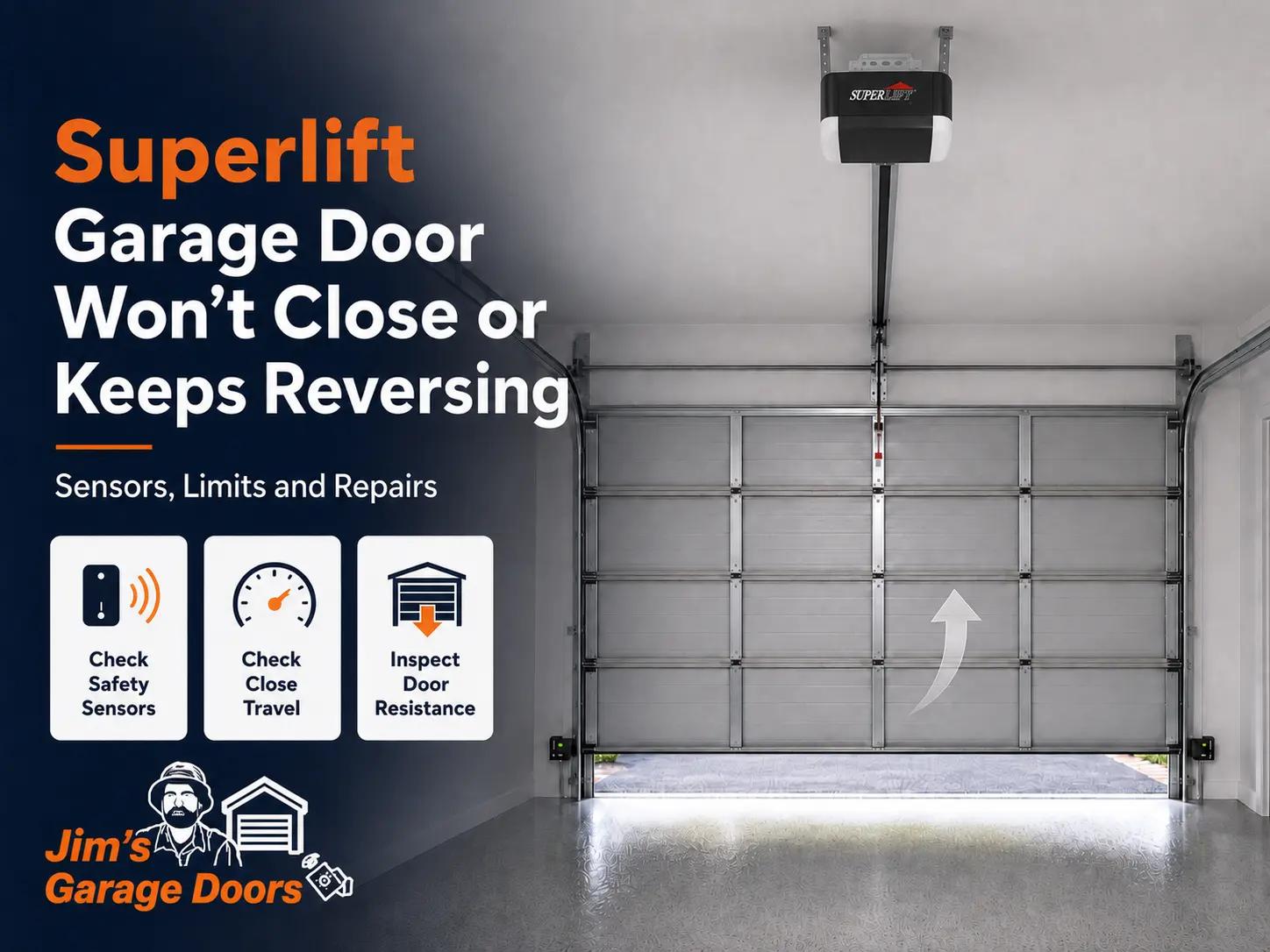
A Superlift garage door may refuse to close or reverse before reaching the floor when the safety sensors are blocked, the close travel is incorrect, or the door meets resistance while moving.
Start by clearing the doorway, cleaning the sensor lenses and checking whether both sensor indicator lights remain steady. If the door still reverses, stops at the same position or moves unevenly, the problem may require sensor adjustment, travel-limit correction or mechanical garage door repair.
Superlift SDO-5 V3, RDO-5 and older S66 openers use different controls, so identify the model before changing any settings.
Prefer not to troubleshoot the fault yourself? Call Jim’s Garage Doors on 131 546 for a Superlift opener and garage door inspection.
What Does Your Superlift Garage Door’s Closing Behaviour Suggest?
Use the door’s movement to identify the likely fault and the safest next step.
| What the door does | Likely cause | Quick safe check | When to call |
|---|---|---|---|
| Will not begin closing | Blocked or misaligned safety beam | Clear the opening and clean the lenses | Sensor lights remain off or unstable |
| Starts closing and reverses | Beam interruption or door resistance | Check where the reversal occurs | It repeats with a clear doorway |
| Stops at the same point | Track, roller, guide or travel fault | Look for a visible obstruction | No obstruction is visible |
| Touches the floor and reopens | Close travel set too far | Do not change the force setting | Travel needs professional correction |
| Closes only while the wall control is held | Sensor or sensor-wiring fault | Check both sensor lights | Cleaning does not restore normal closing |
| One side moves before the other | Cable, track, guide or curtain fault | Stop operating the door | Book repairs immediately |
| Remote will not close the door, but wall control works | Remote, coding or receiver issue | Test another remote | All remotes fail |
Why Won’t Your Superlift Garage Door Close?
A Superlift opener may prevent closing when it detects an interrupted safety beam, an obstruction or abnormal resistance.
The most common causes are:
- An object blocking the doorway
- Dirty or misaligned safety sensors
- Damaged sensor wiring
- Incorrect close travel
- A roller, hinge, track or guide restricting movement
- A roller-door curtain moving unevenly
- A remote, receiver or opener-control fault
Begin with the doorway and sensors. Move to professional diagnosis when those checks do not restore normal closing.
Are the Superlift Safety Sensors Blocked or Misaligned?
Blocked or misaligned safety sensors can prevent the door from closing or make it reverse immediately.
The sensors send a photoelectric signal across the garage opening. When that signal is interrupted, the opener may stop, reverse or refuse to begin the close cycle.
Check for:
- Boxes, tools, toys or vehicles crossing the beam
- Dirt, dust or spider webs on the lenses
- A sensor that has been knocked out of position
- Loose or damaged wiring
- One indicator light being off or flashing
- Bright sunlight affecting one sensor
Clean both lenses with a soft, dry cloth. Remove anything crossing the opening and check whether the indicator lights remain steady.
Do not disconnect, cover or bypass the safety sensors.
When Do Superlift Safety Sensors Need Professional Repair?
Book an inspection when:
- One sensor light remains off
- The lights flicker when the door moves
- Wiring appears loose or damaged
- The door still reverses with a clear opening
- The opener closes only while the wall button is held
These signs can point to sensor alignment, wiring or opener-control trouble.
Why Does Your Superlift Garage Door Start Closing and Then Reverse?
A Superlift door that begins closing and reverses is usually detecting an interrupted beam or more resistance than expected.
The position of the reversal provides a useful clue:
- Immediate reversal: check the safety sensors and doorway first.
- Reversal at the same height: inspect the matching section of track, guide, roller or curtain.
- Uneven closing: stop using the opener and arrange mechanical repairs.
- Reversal near the floor: the close travel or floor contact may need correction.
Do not increase the force setting before the door has been checked. Extra force will not correct a bent track, binding roller, twisted curtain or damaged cable.
Why Does Your Superlift Garage Door Stop at the Same Point?
A door that stops or reverses at the same position is usually meeting a repeatable obstruction or mechanical restriction.
Check that area for:
- A bent track
- A damaged or displaced roller
- A loose hinge
- A sectional-door panel contacting the frame
- Debris inside a track or roller-door guide
- A damaged roller-door curtain
- A cable that is not winding evenly
A repeated stop at one position is unlikely to be caused by a random remote fault. The affected door component should be repaired before the travel settings are changed.
Why Does Your Superlift Garage Door Touch the Floor and Reopen?
A Superlift door that reaches the floor and then reverses may have a close travel setting that extends beyond the correct closed position.
The opener reaches the floor, continues applying downward movement and interprets the resulting resistance as an obstruction.
Signs include:
- Heavy compression of the bottom seal
- The door reaching the floor before the motor stops
- The opener arm or curtain remaining under load
- The fault starting after a reset or travel reprogramming
Do not increase the closing force. The door movement and close position should be checked before the limit is corrected.
Why Won’t a Superlift RDO-5 Roller Door Close Properly?
An RDO-5 roller door may refuse to close or reverse when the photocell input is interrupted, the curtain binds inside a guide or the opener detects abnormal resistance.
Relevant checks include:
- Photocell alignment and wiring
- Roller-door guide condition
- Curtain alignment
- Axle and drum-wheel movement
- Door balance
- Open and close travel settings
Stop operating the door if the curtain looks twisted or one side moves before the other. A reset will not correct a curtain, guide or alignment fault.
Why Does a Superlift SDO-5 V3 Keep Reversing?
An SDO-5 V3 sectional or tilt door may reverse because of a safety-beam fault, incorrect close travel or resistance within the door mechanism.
Check:
- Safety-beam indicator lights
- Sensor wiring
- Sectional-door rollers
- Hinges
- Vertical and horizontal tracks
- Bottom-seal contact
- Close travel
- Door balance
Adjust the opener settings only after the door moves freely and evenly.
Which Superlift Garage Door Checks Can You Safely Do Yourself?
Try the basic checks below when the door is straight, no hardware damage is visible, and the opening is clear:
- Remove objects from the doorway
- Clean both sensor lenses
- Check whether the sensor lights stay steady
- Test the wall control and remote separately
- Note where the door reverses
- Look for debris in accessible tracks or guides
- Confirm that the opener has power
- Photograph the model label and fault
These checks should take only a few minutes.
When Should You Stop Troubleshooting a Superlift Garage Door?
Stop and arrange professional repairs when:
- The door moves unevenly
- One side closes before the other
- A cable is loose, frayed or detached
- A roller has left its track
- A track or guide is bent
- The roller-door curtain is twisted
- The door repeatedly touches the floor and reopens
- Sensor lights remain off or unstable
- Reversal continues after cleaning and clearing the opening
- The opener makes grinding or scraping sounds
- There is a burning smell
Do not adjust spring tension, handle lifting cables, loosen roller-door brackets or remove the opener cover.
Does Your Superlift Opener Need Adjustment or Repair?
Adjustment may solve the problem when the door is mechanically sound, and the fault is limited to sensor alignment or close travel.
Superlift Opener Adjustment May Be Enough:
- A safety sensor has moved slightly
- The travel setting was lost after a reset
- The door moves freely and evenly
- No damaged hardware is visible
- The opener reaches the floor before stopping
Superlift Opener or Garage Door Repair More Likely:
- Sensor wiring is damaged
- The receiver or control system is faulty
- Rollers, hinges, tracks or guides are binding
- The door closes unevenly
- A cable, spring or curtain is damaged
- The fault returns after basic checks
Opener replacement is usually considered only when major internal faults recur, compatible parts are unavailable or repair no longer offers sensible value.
What Will a Technician Check on a Superlift Closing Fault?
A complete Superlift closing-fault inspection should include:
- Safety-sensor alignment and wiring
- Close travel and obstruction response
- Opener controls and receiver operation
- Rollers, hinges, tracks and guides
- Roller-door curtain alignment
- Cable and spring condition
- Door balance
- The position where stopping or reversal occurs
The inspection should identify whether the correct solution is cleaning, alignment, programming, mechanical repair or opener-component replacement.
Book a Superlift Garage Door Closing-Fault Inspection
Try the safe checks first when the door is straight and no damage is visible. If they do not restore normal closing or you would rather not test the opener yourself, Jim’s Garage Doors can inspect the sensors, travel settings, opener controls and garage door mechanism.
Jim’s Garage Doors can assist with:
- Safety-sensor alignment and replacement
- Sensor wiring faults
- Close-travel correction
- Superlift opener controls
- Remote and receiver trouble
- Roller, hinge, track and guide repairs
- Cable and spring faults
- Twisted roller-door curtains
- Door-balance correction
- Opener repair or replacement
Superlift door still refusing to close or reversing after the basic checks? Call Jim’s Garage Doors on 131 546 or request a quote for an inspection.
Superlift Garage Door Opener Faults
If your Superlift opener runs but the garage door does not move, the fault may involve the manual release, trolley, drive system, spring or drum-wheel connection. Read our Superlift garage door motor runs but door won’t move guide.
If the opener is beeping, flashing or displaying E2, E6 or another warning, check our Superlift garage door opener error codes guide.
Frequently Asked Questions
Why Does My Superlift Garage Door Start Closing and Then Reverse?
The opener may detect a blocked safety beam, incorrect close travel or resistance within the door mechanism. Clear the opening and clean the sensors first. Arrange an inspection if the fault returns.
Why Does My Superlift Door Touch the Floor and Reopen?
The close travel may extend beyond the correct closed position. Check the door movement and travel setting before making further adjustments.
Can Dirty Safety Sensors Stop a Superlift Door From Closing?
Yes. Dirt, dust or spider webs can interrupt the photoelectric signal. Clean both lenses gently and confirm that the indicator lights remain steady.
Why Does My Superlift Door Close Only While I Hold the Wall Button?
This commonly points to a safety sensor, sensor wiring, or opener control problem. Do not bypass the sensors.
Who Repairs Superlift Garage Doors That Keep Reversing?
Jim’s Garage Doors can inspect the Superlift opener, safety sensors, travel settings, tracks, guides, rollers, springs, cables and door balance before recommending the correct repair.