
If you are comparing 4Ddoors garage door openers, the GA103, GA203 and 4DS2 should not be treated as simple small, medium and large versions of the same motor.
The GA103 is specified for compatible residential doors up to 12 m² with a maximum push/pull force of 600 N. The GA203 extends to 15 m², provides 750 N of force and has the fastest published opening speed of the three.
The 4DS2 is also specified up to 15 m² but increases maximum push/pull force to 1000 N.
The strongest motor is not automatically the best motor.
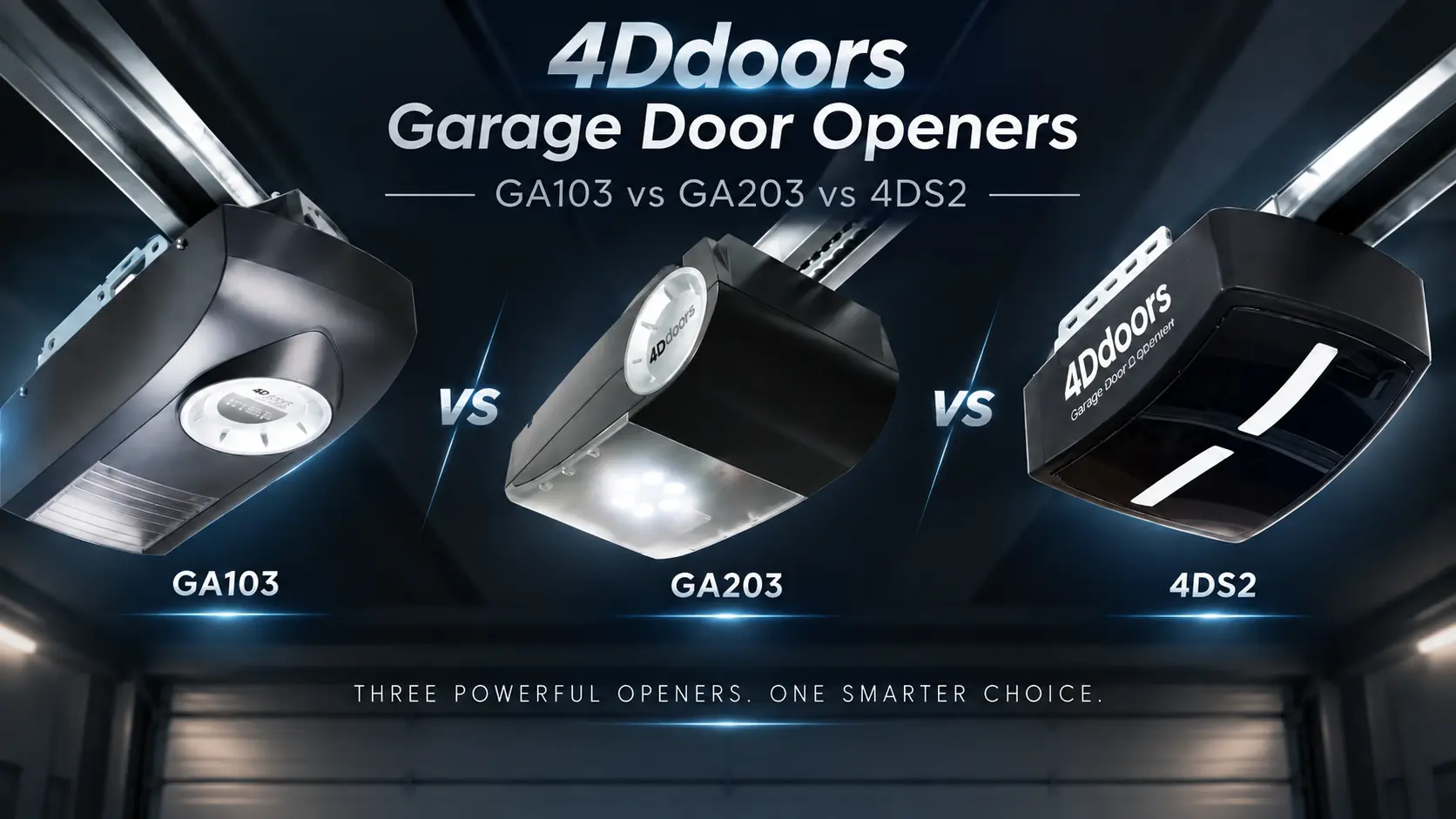
What Is the Difference Between the GA103, GA203 and 4DS2?
The main differences are maximum door area, push/pull force, opening speed, drive system and transmitter capacity.
| Specification | 4Ddoors GA103 | 4Ddoors GA203 | 4Ddoors 4DS2 |
|---|---|---|---|
| Maximum published door area | Up to 12 m² | Up to 15 m² | Up to 15 m² |
| Maximum push/pull force | 600 N | 750 N | 1000 N |
| Approx. opening speed | 135 mm/sec | 220 mm/sec | 160 mm/sec |
| Drive system | Belt | Belt | Chain/belt |
| Coded handset capacity | Up to 35 | Up to 120 | Up to 50 |
| Application | Residential | Residential | Residential |
| Battery backup | Optional | Optional | Optional |
| Photocell beams | Optional; recommended | Optional; recommended | Optional; recommended |
The table shows why a force-only comparison can be misleading.
The GA203 has a lower maximum force than the 4DS2, yet its published opening speed is higher, and its transmitter capacity is substantially larger. The right choice therefore depends on what the complete garage door system requires, not which operator has the biggest Newton figure.
When Is the 4Ddoors GA103 Enough?
The GA103 is the logical starting point for compatible residential garage doors within its 12 m² published area limit when no additional operator capacity is required.
Its key published specifications include:
- maximum push/pull force of 600 N;
- maximum door area of 12 m²;
- approximate opening speed of 135 mm/sec;
- belt-drive operation;
- storage for up to 35 coded handsets.
That makes the GA103 relevant to many conventional residential sectional-door installations.
However, being below 12 m² does not automatically make every door suitable for a GA103. Door type, track arrangement, correct spring balance and the approved door/operator combination still matter.
When Is the Faster 4Ddoors GA203 the Better Choice?
The GA203 is more relevant when the installation requires a compatible operator for a door up to 15 m², faster opening travel, or greater transmitter capacity.
Its published specifications include:
- maximum push/pull force of 750 N;
- maximum door area of 15 m²;
- approximate opening speed of 220 mm/sec;
- belt-drive operation;
- storage for up to 120 coded handsets.
The important distinction is that the GA203 is not simply a middle-strength motor.
Its approximate 220 mm/sec opening speed is the fastest of these three operators, and it also has the highest transmitter capacity.
That may make the GA203 particularly relevant where operating speed or multiple authorised users matter more than having the highest available force rating.
When Is the 1000 N 4Ddoors 4DS2 the Better Choice?
The 4DS2 is the stronger candidate when an approved residential installation benefits from greater available push/pull force while staying within the operator’s 15 m² published door-area limit.
Its core specifications include:
- maximum push/pull force of 1000 N;
- maximum door area of 15 m²;
- approximate opening speed of 160 mm/sec;
- chain/belt drive;
- storage for up to 50 coded handsets.
The 1000 N force rating is the highest of these three operators, but it should be viewed as additional operating capacity rather than a universal performance advantage.
The 4DS2 does not open faster than the GA203, nor does it support as many coded handsets. Its main differentiator in this comparison is the higher maximum push/pull force.
That makes it relevant when the approved door/operator combination calls for greater force headroom, not simply because 1000 N sounds more powerful.
Does a Heavier Insulated Garage Door Always Need a Stronger Motor?
No. An insulated or physically heavier sectional door does not automatically require the opener with the highest force rating because the door should first be correctly counterbalanced by its spring system.
Garage door springs offset much of the effective door weight. A correctly balanced door should therefore move through its tracks without requiring the opener to lift its full static mass from rest.
This is especially important when choosing an opener for insulated sectional systems.
If a door becomes unusually heavy because springs are failing, cables are damaged, or rollers are binding, a stronger motor does not correct the underlying mechanical fault.
For insulated doors such as the 4Ddoors LPU 42 and LPU 67 Thermo, opener selection should consider full door dimensions, balance, track arrangement, and approved operator combinations rather than panel thickness alone.
What Do Homeowners Get Wrong When Choosing a 4Ddoors Opener?
The most common mistake is treating 600 N, 750 N and 1000 N as a simple quality ranking.
They are force specifications, not scores.
Higher Force Does Not Automatically Mean Better
A 1000 N 4DS2 has a higher maximum push/pull force than a 750 N GA203, but the GA203 has a faster published opening speed and greater handset capacity.
The better opener depends on which attributes matter for the actual installation.
A Stronger Motor Cannot Fix Poor Door Balance
If a garage door becomes heavy, uneven or difficult to move, fitting a stronger opener can mask the symptom without repairing the cause.
Assess springs, cables, rollers, and tracks before assuming the existing motor is undersized.
Door Area Alone Does Not Determine Compatibility
The published 12 m² and 15 m² limits are important, but they are not the only selection criteria.
Door type, track system, operating frequency, spring balance and the manufacturer-approved operator combination also influence the final choice.
This is why opener selection should start with the garage door system, not with the largest motor specification.
Which Opener Works With LPU 42 and LPU 67 Thermo Sectional Doors?
There is no responsible one-model answer based only on whether the door is an LPU 42 or LPU 67 Thermo.
Both are insulated sectional systems, but their individual installations can vary significantly in width, height, track configuration and overall door area.
A smaller LPU 42 installation may sit within GA103 specifications, while a larger sectional door may require assessment against GA203 or 4DS2 operating limits.
The practical selection sequence is:
door type and dimensions → track arrangement → correct spring balance → operating requirements → approved opener specification.
This avoids the common mistake of assuming:
LPU 42 = smaller motor
or
LPU 67 Thermo = largest motor
The insulated panel type alone does not determine the answer.
GA103 vs GA203 vs 4DS2: Which 4Ddoors Opener Should You Choose?
The right starting point depends on what the installation actually requires.
| Your Situation | Better Starting Point | Why |
|---|---|---|
| Compatible conventional residential door below 12 m² | GA103 | 600 N operator within its published residential door-area limit |
| Compatible door between 12 m² and 15 m² | GA203 or 4DS2 | Both extend to a published maximum area of 15 m² |
| Faster opening travel is important | GA203 | Approx. 220 mm/sec published opening speed |
| Large transmitter capacity is required | GA203 | Stores up to 120 coded handsets |
| Approved installation benefits from greater force headroom | 4DS2 | Maximum published push/pull force of 1000 N |
| Standard door where additional capacity is unnecessary | GA103 | Avoids selecting a larger operator purely for the specification |
| Door has become heavy, crooked or difficult to move | Inspect the door first | A mechanical fault may be increasing operating resistance |
The distinction can be summarised simply:
-
- GA103: suitable starting point for compatible conventional residential doors within 12 m².
- GA203: stronger fit where the 15 m² area range, faster opening speed or higher transmitter capacity matters.
- 4DS2: strongest force specification of the three, suited where the approved installation genuinely benefits from greater push/pull capacity.
The best operator matches the door, not necessarily the one with the largest motor-force number.
What If Your Existing 4Ddoors Opener Is Struggling?
If an opener that previously operated normally suddenly becomes slow, noisy or unable to move the door consistently, do not assume that replacing it with a stronger motor is the correct solution.
A change in door resistance can be caused by:
- weakened or damaged springs;
- cable problems;
- rollers binding;
- track alignment issues;
- deteriorating hardware;
- an opener fault itself.
If the door is also reversing, refusing to close or behaving inconsistently, see our 4Ddoors garage door won’t close troubleshooting guide before assuming the opener needs replacement.
Need Help With an Existing 4Ddoors Garage Door Opener?
If your existing 4Ddoors garage door or opener has become slow, noisy, unreliable or difficult to operate, the fault may involve the motor or another part of the door system.
Jim’s Garage Doors can inspect the operation of an existing garage door, springs, cables, tracks and automatic opener and advise on suitable servicing or repair options.
Call 131 546 or submit an online enquiry to arrange an assessment.