
A 4Ddoors garage door that will not close, reverses before reaching the floor or suddenly stops responding can have a simple obstruction or control issue, but the same symptoms can also indicate an opener fault or a mechanical problem with the door.
Start with safe, non-invasive checks: make sure the opening is clear, confirm the opener has power, test another control if available, and inspect photoelectric safety beams where fitted.
If the door is crooked, unusually heavy, off its tracks, has a damaged spring or cable, or makes severe mechanical noises, stop operating it and arrange a professional inspection.
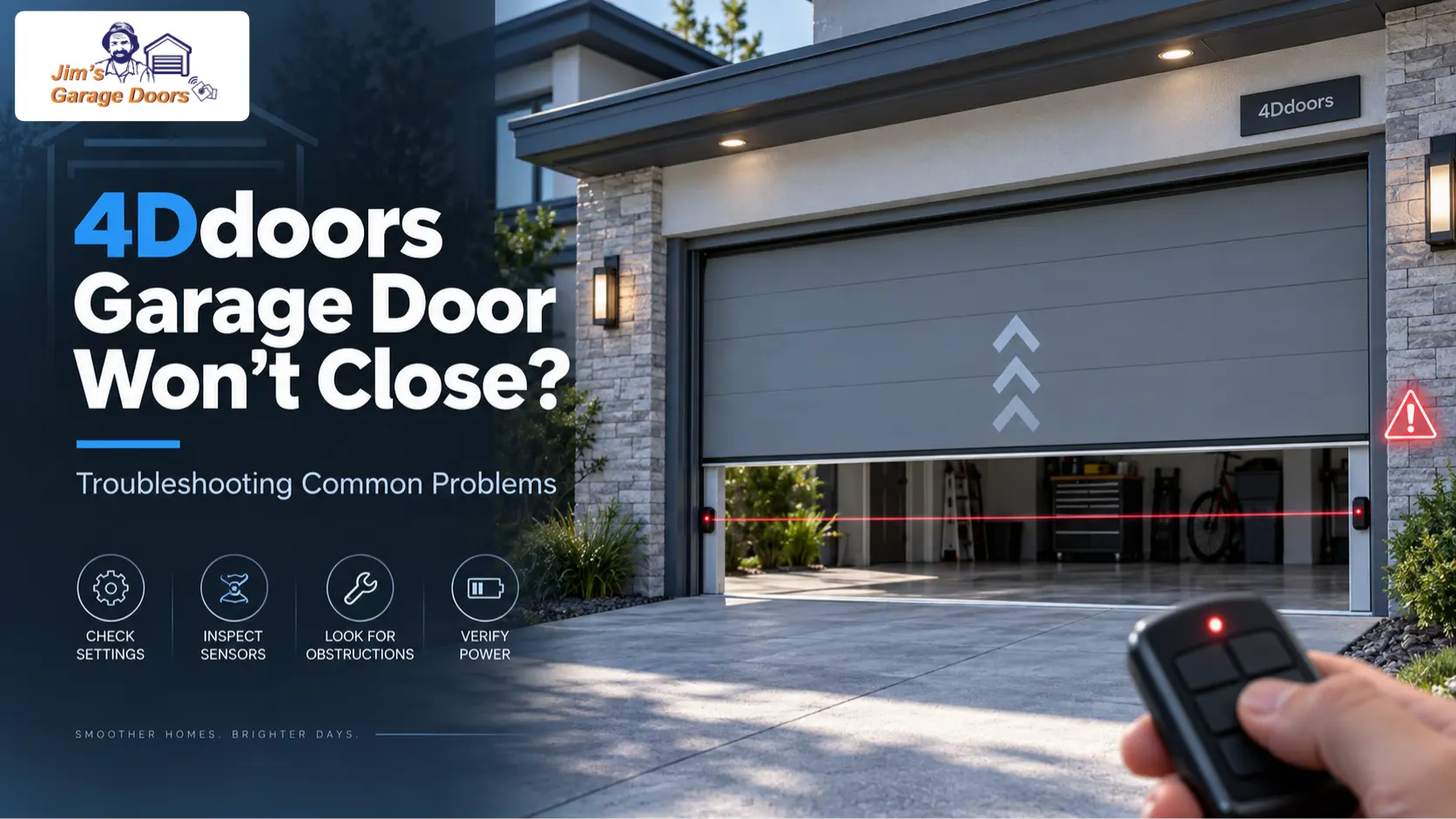
Why Won’t My 4Ddoors Garage Door Close?
A 4Ddoors garage door may not close because a safety device has been triggered, the opener has lost a control or travel setting, or the door itself has developed mechanical resistance.
The symptom is usually the best place to start.
| Symptom | Likely Area to Check First | Safe Next Step |
|---|---|---|
| Door starts closing then reverses | Obstruction, safety beam or resistance | Clear visible obstructions and inspect fitted safety beams |
| One remote fails, but another control works | Remote/transmitter | Check the battery and coding |
| No controls operate the opener | Power or opener/control fault | Confirm power supply, then arrange diagnosis if still unresponsive |
| Door stops at the same point repeatedly | Resistance, track issue or travel setting | Stop repeated cycling and inspect door movement |
| Door is visibly crooked | Cable, spring or track problem | Stop operating |
| Door feels unusually heavy | Spring or balance problem | Arrange professional inspection |
| Opener runs, but the door does not move correctly | Drive connection or mechanical door fault | Stop and inspect the complete system |
The key distinction is that a door that will not close doesn’t automatically mean the motor has failed.
Is Something Blocking the Door or Safety System?
Yes. An obstruction or activated safety system should be one of the first things to check when the door begins closing and then reverses.
Look for obvious objects in or around the opening, including:
- bins;
- tools;
- toys;
- stones or debris;
- stored items projecting into the door path.
Where photoelectric safety beams are fitted, make sure nothing is blocking the beam and that the sensors have not been knocked out of alignment.
Do not bypass, cover or permanently disable a safety device to force the door closed.
If the opening is clear and the door keeps reversing, the next step is to determine whether the resistance is coming from the opener or the door itself.
Why Does My 4Ddoors Garage Door Close and Then Reverse?
A door that closes partway and reverses may be responding to an obstruction, a safety input or abnormal mechanical resistance.
Possible causes include:
- interrupted safety beams;
- an object in the door path;
- rollers binding;
- track resistance;
- poor spring balance;
- incorrect travel limits or learned positions;
- another opener safety condition.
A useful clue is whether the problem occurs at the same point of travel every time.
If it does, check the area around that position for visible obstruction or resistance. If nothing obvious is present, avoid repeatedly cycling the door because the opener may be reacting to a mechanical problem that needs inspection.
What If the 4Ddoors Remote Does Not Work?
If one remote doesn’t operate the door but another remote or wall control still works, the problem is more likely the transmitter than the garage-door opener itself.
Check:
- the remote battery;
- whether the transmitter indicator operates;
- whether another programmed remote works;
- whether the handset needs model-specific recoding.
4Ddoors opener models use different transmitters and coding procedures, so use the instructions for your opener.
If none of the controls works, shift the diagnosis toward the opener’s power supply, control system or the door itself.
Could the 4Ddoors Garage Door Opener Be the Problem?
Yes. The opener becomes more suspect when it has power but doesn’t respond correctly, displays a diagnostic fault, loses its travel positions, or behaves abnormally even though the door moves freely.
Possible opener-related symptoms include:
- no response from any control;
- diagnostic lights or error indications;
- lost open or closed positions;
- repeated stopping without obvious door resistance;
- control or sensor faults.
A reset should not automatically be the first solution.
Different 4Ddoors openers use different setup and learning procedures, and resetting the system can erase learned settings without correcting the original fault.
If you are considering replacing the opener rather than diagnosing the existing unit, see our 4Ddoors GA103 vs GA203 vs 4DS2 garage door opener comparison.
Could the Garage Door Be Too Heavy or Mechanically Jammed?
Yes. If the physical garage door has become heavy, uneven or difficult to move, the opener may stop or reverse even when the motor itself is operating normally.
Mechanical causes can involve:
- springs;
- lifting cables;
- rollers;
- hinges;
- tracks;
- door balance.
The opener is designed to move a correctly functioning, properly counterbalanced door. It should not be expected to compensate for deteriorating mechanical components.
This is particularly important with insulated sectional systems such as the 4Ddoors LPU 42 and LPU 67 Thermo. Panel construction does not remove the need for correct spring balance and smooth mechanical movement.
What Do Homeowners Get Wrong When Troubleshooting a 4Ddoors Door?
Three assumptions commonly lead to unnecessary or potentially damaging troubleshooting.
“If I Keep Pressing the Remote, It Might Clear the Fault”
Repeated cycling does not fix a mechanical problem.
If the door repeatedly reverses, moves unevenly or makes abnormal noises, continuing to operate it can place additional load on the opener and lifting system.
“A Stronger Motor Will Fix a Heavy Door”
It will not fix the cause.
If a door has become abnormally heavy, the problem may involve the spring or lifting system. Installing a higher-force opener can mask the symptom while leaving the mechanical fault unresolved.
“If the Door Reverses, the Motor Must Be Faulty”
Not necessarily.
An opener can reverse because it detects an obstacle, a safety input or excessive resistance from the door itself.
The motor is only one part of the complete system.
When Should You Stop Troubleshooting the Door Yourself?
Stop operating the garage door when continued movement could worsen a spring, cable, track or balance fault.
Arrange professional inspection if you see:
- a broken or visibly damaged spring;
- a loose, frayed or snapped cable;
- one side of the door sitting higher than the other;
- rollers leaving the track;
- bent or displaced tracks;
- the door becoming unusually heavy;
- severe grinding, banging or binding;
- panels twisting during movement.
Do not attempt to adjust garage-door springs or lifting cables yourself. These components operate under substantial stored tension.
Removing an obstruction or replacing a remote battery is very different from adjusting the lifting system.
Is It a 4Ddoors Opener Problem or a Garage Door Problem?
Use the behaviour of the complete system rather than assuming which component has failed.
| What You Notice | More Likely Area | Best Next Step |
|---|---|---|
| One remote fails, other controls work | Remote/transmitter | Battery or coding check |
| No controls respond | Power/opener | Check power, then diagnose opener |
| Door reverses but stays straight | Safety/resistance/travel | Check safe visible causes |
| Door is crooked | Mechanical door | Stop operating |
| Door feels abnormally heavy | Spring/balance system | Professional inspection |
| Motor sounds normal, but door binds | Mechanical door | Inspect tracks, rollers and lifting system |
| Door moves freely, but opener behaves incorrectly | Opener/control system | Model-specific diagnosis |
The key rule is simple:
If the physical door is heavy, crooked or binding, investigate the door before replacing or upgrading the motor.
What Should You Do If the Door Still Won’t Close?
If the basic checks do not identify the problem, the next step is to diagnose the opener and mechanical door as one system rather than replacing parts by assumption.
A technician can determine whether the problem involves:
- the remote or controls;
- safety devices;
- opener settings or electronics;
- springs or balance;
- cables;
- rollers;
- tracks.
Regular servicing can also help identify developing resistance in these components before it begins causing closing or reversal faults.
Need Help With a 4Ddoors Garage Door That Won’t Close?
If your existing 4Ddoors garage door is reversing, crooked, noisy, difficult to operate or refusing to close, Jim’s Garage Doors can inspect the door and automatic opener and identify whether the fault involves the motor, springs, cables, tracks or another part of the system.
Call 131 546 or request a quote to arrange an assessment.