
Jim’s Garage Doors provides garage door repairs in Russell Lea NSW 2046, including broken springs, snapped cables, damaged tracks, roller and tilt door faults, and automatic garage door opener problems.
A door that stops, lifts unevenly or refuses to open may have more than one possible cause. The repair depends on identifying the failed component, checking for related damage and determining whether the existing mechanism can operate safely after repair.
Garage door faults can involve the lifting mechanism, tracks, rollers, door panels or automatic opener. The visible symptom helps narrow the inspection, but does not confirm which component has failed.
| Garage Door Symptom | What a Technician Checks | Possible Repair |
|---|---|---|
| Door is heavy or will not lift | Spring balance, lifting components and track resistance | Spring replacement or correction of mechanical resistance |
| Door hangs unevenly | Cables, drums, rollers and track alignment | Cable repair, hardware replacement or track correction |
| Motor runs but door stays still | Drive connection, opener mechanism and door condition | Drive repair, reconnection or opener replacement |
| Door reverses while closing | Safety sensors, travel settings and mechanical binding | Sensor correction or repair of the underlying resistance |
| Door scrapes, catches or becomes noisy | Rollers, tracks, hinges, bearings and panel condition | Component replacement or alignment repair |
A door with a broken spring, loose cable or displaced roller should not be operated. Forcing it open or repeatedly activating the motor can worsen the damage and create a safety risk.

Similar garage door symptoms can have different causes. A technician checks the lifting system, alignment and mechanical resistance before selecting the repair.
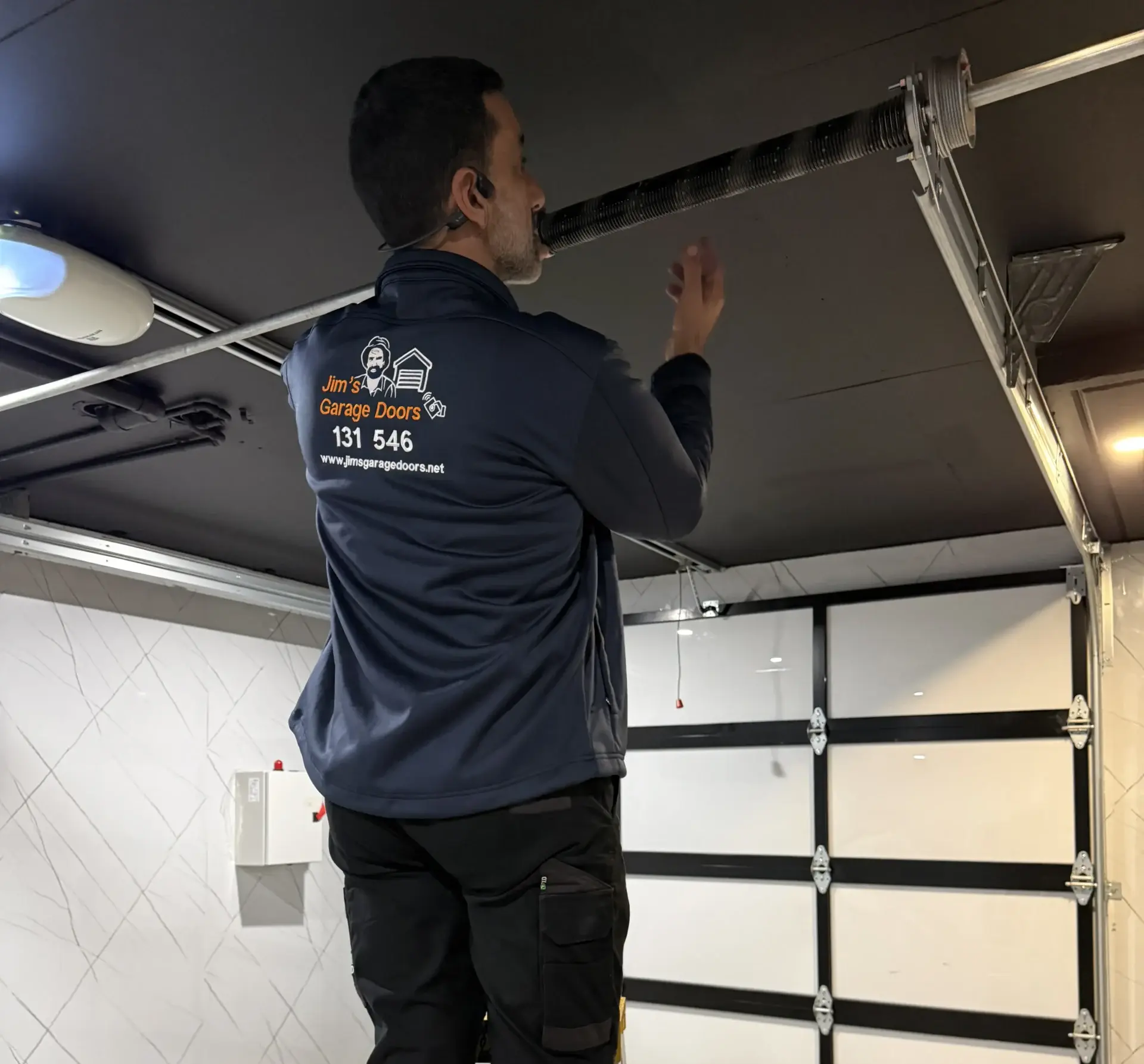
The technician checks springs, bearings, lifting hardware and tracks. A broken spring requires a correctly specified replacement followed by balance testing. If the door binds at a particular position, damaged rollers or tracks may be responsible instead.
The technician secures the door and inspects cables, drums, rollers and tracks. Damaged components are repaired or replaced, and the cause of misalignment is corrected before testing.
The final check confirms even door travel, correct cable positioning and smooth operation. Simply straightening the door without fixing the cause can lead to recurring faults.
Different garage door designs use different lifting and guidance systems. The technician must assess the components specific to each mechanism.
A roller door winds around an overhead barrel and moves within side guides. When the curtain jams or travels sideways, the technician examines the guide channels, curtain edges, barrel alignment and spring assembly.
Repair may involve correcting guide alignment, replacing damaged components or addressing a counterbalance fault. If the curtain is distorted, guide adjustments alone may not restore smooth operation.
Sectional doors use hinged panels moving along roller tracks, supported by a counterbalance system. The technician checks lifting cables, drums, springs, rollers, hinges and panel connections.
A damaged roller or hinge may be replaceable, while a distorted panel requires assessment of the surrounding sections and track alignment. A replacement panel must be compatible with the existing door before installation is recommended.
Tilt doors operate as a single panel supported by pivot arms and a counterbalance mechanism. The technician examines spring condition, pivot wear, mounting points and the door’s movement through its opening arc.
Worn pivots or springs may be replaceable, but distorted mounting points or an unsound door structure can make isolated component replacement unsuitable.
Some established residential properties in Russell Lea have garage arrangements where older hardware, limited clearance or restricted access must be considered before repairing or replacing a mechanism. These conditions do not apply to every property, but they can change the repair method.
A replacement spring or pivot arm must suit the door’s weight and movement geometry. Similar-looking components are not necessarily interchangeable.
Before replacing an opener or modifying a sectional door system, the technician checks the available space for tracks, drive rails and door travel.
Roller door spring or barrel repairs may require additional access or controlled dismantling where walls or other structures obstruct the working area.
The important decision is whether compatible components can restore safe operation without changing the door’s intended movement. If the structure remains sound, retaining the existing garage door may be practical. Where essential components are unavailable or the mechanism cannot be restored safely, replacement may be more appropriate.
A working motor can struggle when the garage door has mechanical resistance, faulty sensors or incorrect travel settings. A technician checks both the door and opener before recommending repairs.
Motor runs, but the door stays still: The technician checks the drive connection and opener components. A disconnected trolley may need reconnection, while a failed drive component may require repair or replacement.
Door closes, then reverses: The technician checks safety sensors, tracks, rollers and door balance. Mechanical resistance is corrected before adjusting opener settings.
Repairs include operational and safety-reversal testing. Increasing motor force will not fix a binding door.
Explore Jim’s garage door openers for motor replacement and automation options.
Repair is generally worth considering when the problem is confined to replaceable components and the remaining garage door is structurally sound. Replacement becomes a consideration when essential parts are unavailable, structural damage is extensive or the cost of restoring the mechanism is disproportionate.
A technician should consider the condition of the complete mechanism rather than recommending replacement based solely on the age of the door.
Garage door repair costs depend on the confirmed fault, replacement parts, labour and accessibility of the installation.
For example, two sectional doors may both hang unevenly. One may require a lifting cable replacement, while the other may have damaged rollers, tracks and panel connections. Although the symptoms look similar, the repair work and cost differ.
Older components, restricted access and the availability of compatible parts can also affect the quotation. An inspection helps determine whether the work involves an isolated component repair or a more extensive mechanical problem.
A garage door repair assessment follows a sequence designed to identify the fault before work begins.
Examine its position, visible damage, springs, cables, tracks and supporting hardware. Secure unstable components before further assessment.
Assess the relevant mechanical system and, where safe, door movement and balance. Check opener components if automatic operation is affected.
Identify the failed components, check for related damage and establish whether suitable replacement parts are available. Explain the proposed work and quotation.
Complete the authorised repair and check door travel, alignment, balance and applicable opener safety functions before returning the system to service.
The objective is to correct the underlying fault and verify the repaired system, not simply make the door move again.
When requesting a garage door repair in Russell Lea, explain what happens when you try to operate the door.
Useful information includes the door type, whether it is stuck open or closed, unusual noises, visible damage and whether the motor runs.
Mention if a vehicle is trapped inside or garage access is restricted. Photographs taken from a safe position may also help illustrate the problem.
Do not attempt to move an unstable door or touch springs, cables or other tensioned components to investigate the fault.
Jim’s Garage Doors provides garage door repair services in Russell Lea and surrounding Inner West Sydney suburbs, including Five Dock, Rodd Point, Wareemba, Drummoyne and Abbotsford.
Customers in surrounding areas can enquire about roller, sectional, tilt and automatic garage door repairs.
Often, if the door structure is sound and compatible springs, pivot arms or other lifting components are available. A technician must assess the mechanism, mounting points and movement before confirming repairability.
Explain the situation when booking. The technician will need to assess whether the door can be safely supported, repaired or otherwise accessed. Do not force the door open or disengage the opener if the lifting system may be damaged.
Stop operating the door. Uneven movement may indicate damaged cables, springs, rollers or tracks. A technician should secure the door, identify the failed components and correct the underlying fault before testing its movement.
Yes, if a compatible replacement panel is available and the remaining door structure is sound. The technician checks the hinges, tracks and adjacent panels to determine whether individual panel replacement is suitable.
Possible causes include obstructed safety sensors, incorrect travel settings or mechanical resistance from damaged rollers or tracks. A technician checks the safety system and door movement before recommending adjustments or repairs.
Whether your garage door is stuck, lifting unevenly, scraping against its tracks or failing to respond to its opener, the repair begins with identifying the cause. Jim’s Garage Doors can assess the mechanism, explain suitable repair options and provide a quotation for the required work.
Enter your postcode to check local technician availability. We service and repair all garage door brands.