
Jim’s Garage Doors provides garage door repairs in Adelaide CBD SA 5000, including roller door repairs, sectional and tilt door repairs, broken spring replacement, cable repairs, track alignment and automatic opener fault diagnosis.
A garage door that jams, hangs unevenly or refuses to open requires an assessment of the lifting mechanism, door alignment and automatic opener before the appropriate repair can be determined.
For Adelaide CBD garages with narrow laneway access, limited headroom or no separate entrance, the available working space can also affect how repairs are undertaken.
Garage door faults commonly involve springs, cables, rollers, tracks, door panels or automatic opener components. The visible symptom helps narrow down the problem, but the failed component must be identified before repairs begin.
| Garage Door Problem | Possible Cause | Technician Assessment |
|---|---|---|
| Door suddenly feels heavy | Broken or weakened spring | Spring condition and door balance |
| Door hangs crooked | Displaced cable or drum | Cable engagement, drums and alignment |
| Door jams or scrapes | Bent track or worn roller | Track geometry and points of resistance |
| Motor runs but door stays still | Drive or mechanical fault | Opener coupling and lifting mechanism |
| Door reverses unexpectedly | Sensor, travel limit or resistance fault | Safety controls and door travel |
| Roller door winds unevenly | Curtain, guide or barrel misalignment | Curtain alignment and barrel supports |
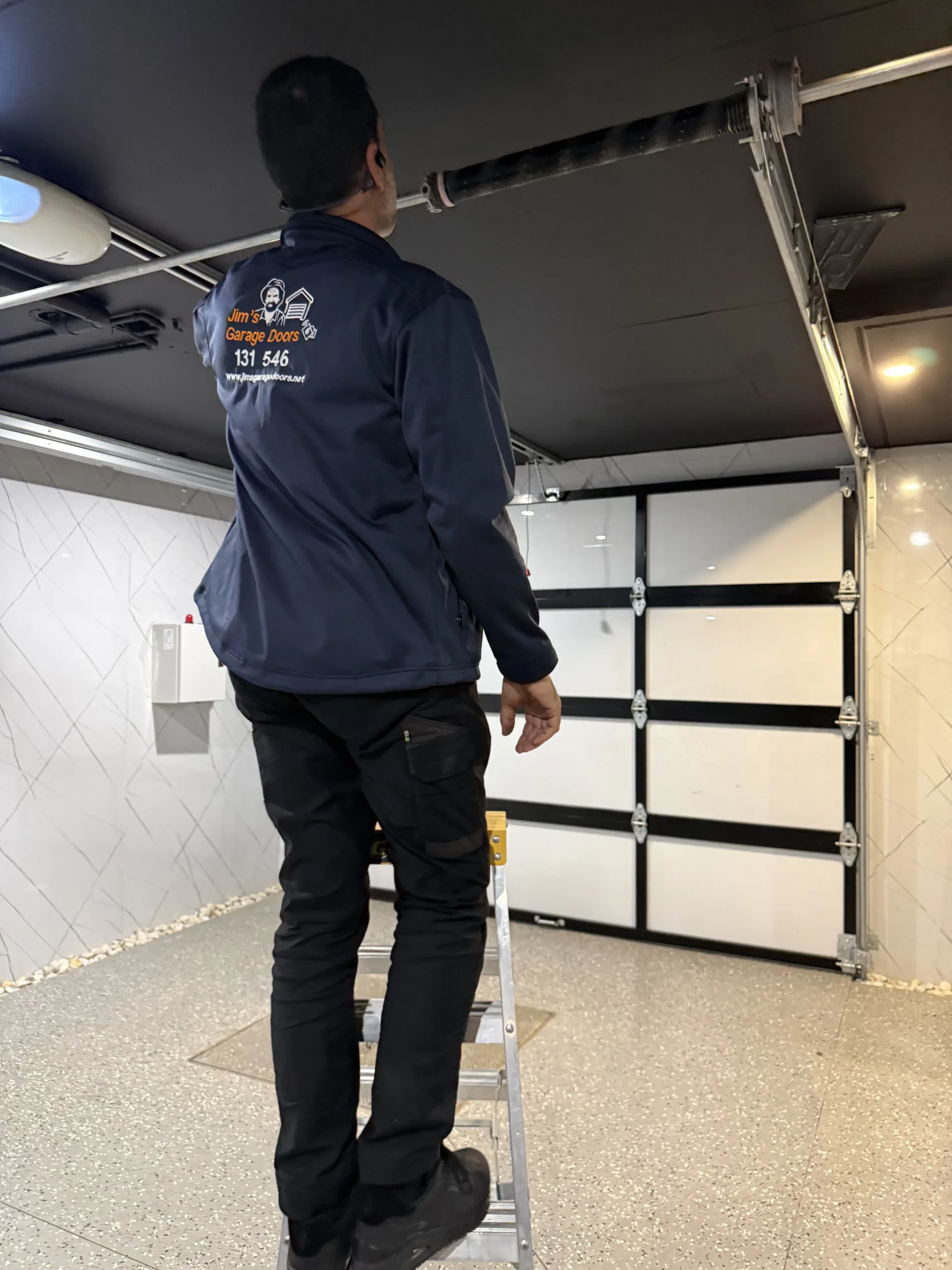
If a sectional door hangs lower on one side, the technician checks whether the lifting cable has left its drum, the drum has shifted or damaged rollers are preventing the door from moving squarely.
A displaced cable may require replacement or re-engagement, but damaged drums, mounting hardware or track alignment must also be addressed where they contributed to the failure.
Similarly, a heavy garage door may indicate a spring problem rather than a faulty motor. Checking the lifting system first helps avoid replacing a functioning opener.
The repair must address the cause of the failure, not simply restore movement temporarily.
Jim’s Garage Doors repairs common residential roller, sectional, panel lift and tilt garage doors. Each system has different lifting components and repair requirements.
Roller doors wind around a barrel mounted above the opening. Common faults include damaged springs, misaligned guides, worn bearings, curtain damage and motor problems.
If the curtain winds unevenly, the technician checks whether the barrel remains correctly supported and whether the guides or curtain have become distorted.
Guide adjustment may be sufficient when the curtain remains sound. A damaged barrel assembly or severely distorted curtain may require more extensive repairs.
Sectional doors operate through hinged panels, rollers, tracks, lifting cables and a spring-assisted mechanism.
When a panel lift door becomes crooked, the technician checks cable tension, drum alignment and roller engagement. The condition of adjoining hinges and tracks is also assessed if a panel has sustained impact damage.
Repairs may involve replacing worn components, correcting alignment or replacing damaged panels where compatible parts are available.
Tilt doors use a single panel supported by springs, pivots and lifting arms.
When a tilt door binds or becomes difficult to lift, the technician checks the pivot assemblies, spring condition, mounting points and panel movement.
Repair may be practical if the structure remains sound and replacement components are compatible with the existing mechanism.
An automatic garage door that stops or reverses does not necessarily have a defective motor. Mechanical resistance, incorrect travel settings, safety sensor faults or a problem within the opener can produce similar symptoms.
The technician first checks for visible mechanical damage or instability.
Where safe, door movement and balance can be assessed independently of the opener. A door that binds or becomes unusually heavy requires mechanical attention before the opener can be evaluated properly.
If the door moves correctly independently, the technician checks the opener drive, coupling, controls, travel settings and safety sensors.
For example, if the motor runs but the door remains stationary, a disengaged drive or damaged coupling may be responsible. If the opener stops under load, excessive door resistance may be the underlying problem.
Motor replacement may be appropriate when the opener has a significant internal failure, compatible parts are unavailable or the unit is unsuitable for the door.
Before selecting a replacement, the technician considers door weight, operating requirements, opener compatibility and available mounting clearance.
See our garage door openers and remotes for further information.
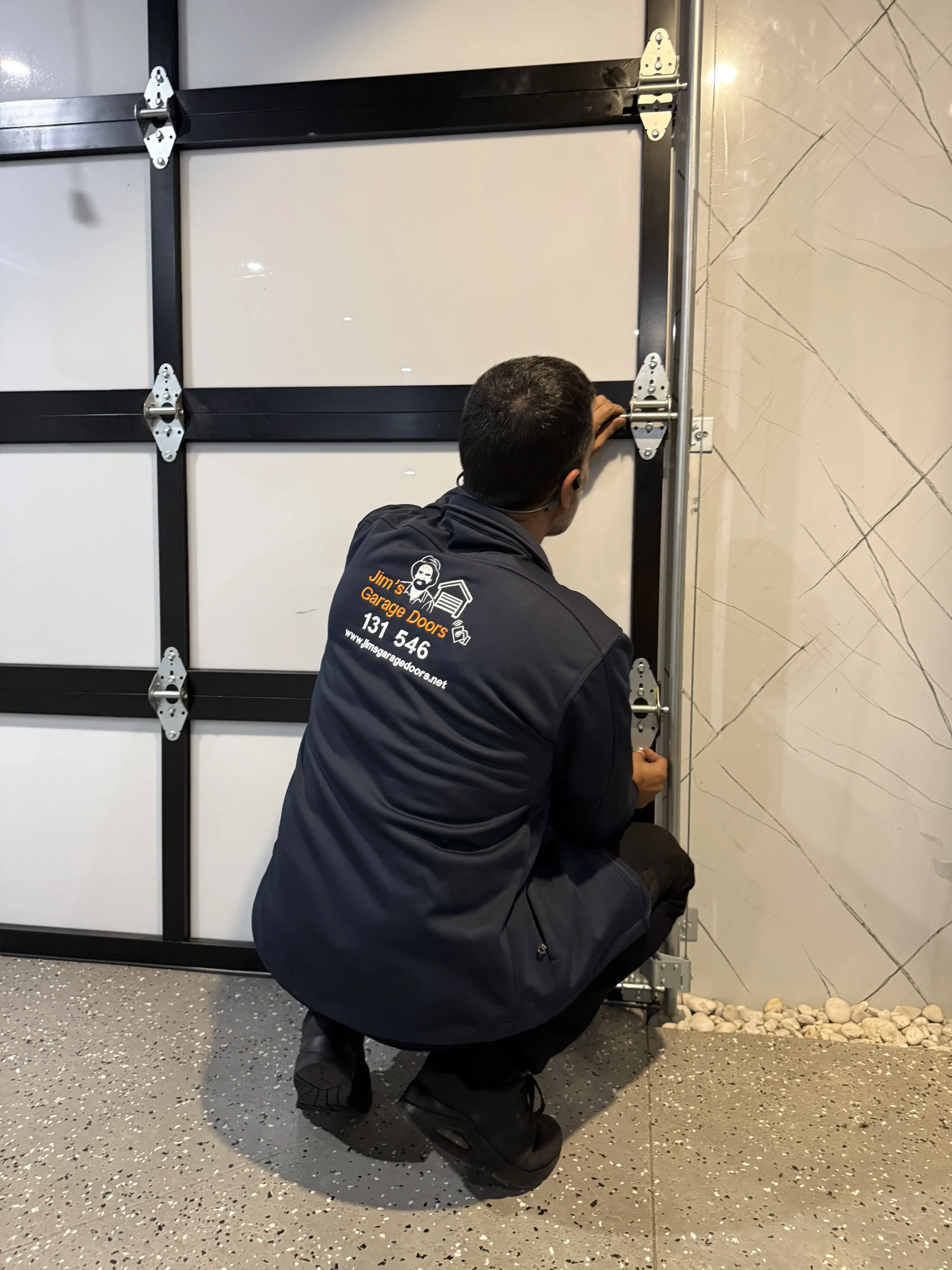
Stop operating a garage door that is crooked, partially detached, unusually heavy or unable to move normally. The immediate priority is to determine whether the door is stable enough to inspect and repair.
A door stuck open may leave the garage unsecured, but pulling it closed can be dangerous if lifting components have failed.
The technician checks what is supporting the door, including spring condition, cable engagement, roller position and mounting hardware.
If a cable has failed, the door may carry an uneven load. The technician must establish how to support and stabilise it before repairing the affected components.
Where replacement parts are unavailable, temporary securing may be considered if the door’s condition permits. It cannot be guaranteed for an unstable installation.
A vehicle may become trapped because a broken spring has left the door too heavy to lift or a displaced cable has caused it to jam.
The technician determines whether the failure involves the opener or the lifting mechanism and whether the door can be safely supported.
Restoring access may require repairing the failed mechanism rather than simply disengaging the motor.
When requesting assistance, explain whether the garage has another entrance and whether the vehicle is urgently required.
An uneven door can indicate that its lifting cables, rollers or tracks are no longer supporting it correctly.
The technician examines cable engagement, track condition and mounting points to determine how the door can be stabilised.
Once adequately supported, the damaged components can be addressed and the door’s alignment checked.
Do not attempt to straighten an unstable door, lift it using a vehicle or adjust spring and cable mechanisms yourself. For a stuck or unsafe garage door in Adelaide CBD, call 131 546 and describe the door’s condition and current position.
Repair is generally worth considering when the door structure remains sound and compatible components can restore safe operation.
For example, a sectional door with a damaged cable may be repaired if the drums, tracks, spring assembly and panels remain serviceable.
Replacement becomes more relevant when the door has severe structural distortion, extensively damaged sections, deteriorated mounting points or obsolete components that cannot be replaced.
For a compact Adelaide CBD garage, replacement must also account for the existing opening dimensions, headroom, side clearance and compatibility with the proposed lifting system.
The decision should be based on structural condition, parts availability, repair feasibility and overall cost not the age of the door alone.
Garage door repair costs depend on the failed component, replacement parts, labour and accessibility.
A straightforward roller replacement involves different work from repairing displaced cables, damaged tracks and associated spring problems.
Restricted headroom or difficult laneway access may also affect the work required.
The technician identifies the failed components and any related damage before recommending a repair and confirming the quotation.
An inspection may be necessary to establish the repair scope and accurate cost.
Accurate information about the fault and garage access helps the technician understand the likely repair requirements before attending.
For Adelaide CBD properties, the following details are particularly useful:
Roller, sectional, panel lift or tilt. Include the opener brand or model if readily available.
Explain whether the door became heavy, made a loud noise, moved unevenly, reversed or stopped responding.
Confirm whether the door is fully closed, partly open, stuck overhead or hanging crooked.
Mention any side entrance, narrow laneway, shared driveway, low ceiling or vehicle obstructing the work area.
Describe damaged panels, cables, tracks or rollers. Provide photographs only when they can be taken safely.
Confirm whether a landlord, property manager or building representative must provide access or authorisation.
The technician may approach the same mechanical fault differently depending on whether the garage is accessible internally.
For example, a broken spring in a garage with a separate entrance may be accessible for inspection. If the faulty door is the only entrance and remains closed, an additional access assessment may be required.
Providing this information helps identify potential difficulties before the appointment without replacing an on-site diagnosis.
A garage door repair generally involves four stages:
Examine the door, lifting mechanism, opener and relevant access restrictions.
Identify failed components, associated damage and suitable repair options.
Complete approved work where compatible parts and safe working conditions allow.
Check door balance, alignment, smooth movement and relevant opener and safety functions.
For example, after a sectional door cable repair, the technician should confirm that the door travels evenly and the cables remain correctly engaged throughout the operating cycle.
A repair is not complete simply because the door moves once; the underlying fault must be addressed and operation checked.
Where the door remains operational but shows signs of wear, garage door servicing may help identify developing problems.
Possibly. The technician checks whether the impact affected only a panel or curtain section, or whether tracks, hinges, rollers and supporting components were also damaged.
Minor damage may be repairable. Severe distortion or unavailable matching parts may make replacement more practical.
First establish whether power has been restored to the opener. If the motor has power but the door remains unresponsive, the fault may involve its controls, drive system or the door mechanism.
Do not force the door or use the manual release if it appears damaged or unbalanced.
That depends on available working space and the location of the damaged components.
The technician may require access around the spring assembly, tracks, barrel or opener. Mention restricted parking space when arranging the appointment.
The technician can assess whether a compatible alternative is suitable or whether another repair option is practical.
If the necessary part cannot be obtained immediately, further work may need to be scheduled. Temporary securing depends on the door’s condition and cannot be guaranteed.
Find Jim’s Garage Doors at Suite 8, Level 30, 91 King William Street, Adelaide SA 5000.
Jim’s Garage Doors Adelaide CBD
Suite 8, Level 30
91 King William Street
Adelaide SA 5000
Australia
For garage door repairs, servicing and appointment enquiries in Adelaide CBD, contact Jim’s Garage Doors on 131 546.
Jim’s Garage Doors assists with residential garage door repairs across Adelaide and selected South Australian service areas.
Enter your postcode to check local technician availability. We service and repair all garage door brands.