
Is your garage door stuck, hanging crooked, making unusual noises or refusing to open? Jim’s Garage Doors provides garage door repairs in Putney NSW 2112, including broken springs, damaged cables, misaligned tracks, roller door faults and automatic garage door opener problems.
A garage door that stops working does not necessarily need a new motor or complete replacement. The problem may involve one damaged component, an incorrectly balanced door or mechanical resistance affecting the opener.
A professional inspection helps identify the fault, assess the condition of the operating mechanism and determine which repairs are appropriate.
Jim’s Garage Doors handles faults affecting roller, sectional and tilt garage doors, including their lifting mechanisms and automatic openers. The appropriate repair depends on the damaged component and the condition of the surrounding system.
| Garage Door Problem | What the Technician Checks | Possible Repair |
|---|---|---|
| Broken spring or unusually heavy door | Spring assembly, counterbalance system and door weight | Replace the defective spring with a correctly specified component |
| Snapped cable or crooked door | Lifting cables, drums, springs and door alignment | Replace damaged cables and correct contributing faults |
| Bent tracks or jammed rollers | Track alignment, rollers, brackets and impact damage | Realign or replace affected components |
| Noisy or uneven sectional door | Hinges, rollers, panel alignment and lifting hardware | Replace worn components and correct alignment |
| Roller door jammed in its guides | Curtain condition, guide clearance, shaft and spring assembly | Repair or replace damaged components where feasible |
| Automatic garage door not operating | Mechanical resistance, opener drive, controls and safety sensors | Repair the identified fault or replace the opener if necessary |
For example, a displaced lifting cable may be associated with a damaged drum or spring problem. Replacing the cable without identifying the cause could leave the mechanism unsafe or unreliable. The inspection therefore considers the complete operating system, not just the part that appears broken.
A heavy, uneven or jammed garage door may have a spring, cable, roller or track fault. The technician identifies the cause before recommending repairs.
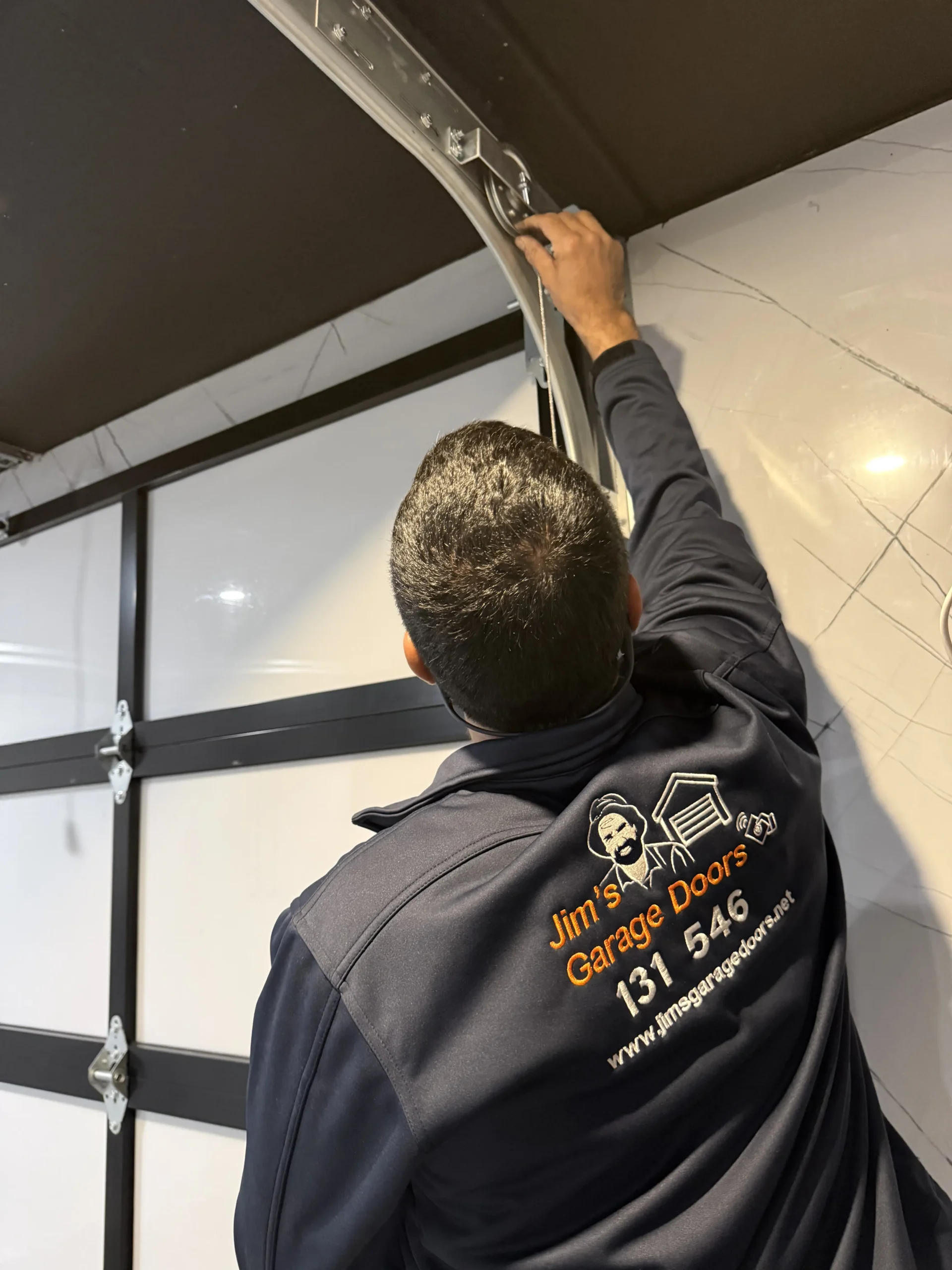
An unusually heavy door may indicate a broken spring or counterbalance fault. The technician checks spring condition and lifting hardware before selecting replacement components and testing door balance. A stronger motor cannot correct a failed spring.
A crooked sectional door may have a damaged cable, displaced drum or alignment fault. After securing the unstable door, the technician identifies affected components, carries out suitable repairs and checks balanced movement.
A door that jams or moves unevenly may have bent tracks, worn rollers or damaged panels. The technician identifies points of resistance and determines whether alignment correction or component replacement is required.
Stop operating a crooked or unstable garage door, particularly if springs or cables are damaged. Do not force it open or attempt manual release.
Book a professional fault inspection in Putney.
The repair procedure depends on the door’s construction. Each system uses different components to support, guide and move the door.
Roller doors operate by winding a metal curtain around a shaft above the garage opening.
When a roller door jams, moves sideways or becomes difficult to lift, the technician assesses its guides, curtain alignment, shaft, bearings and spring assembly.
A misaligned guide or damaged bearing may be repairable without replacing the complete door. However, a severely distorted curtain or damaged supporting mechanism may require more extensive work.
Sectional doors use hinged panels travelling along tracks, supported by rollers, cables and springs.
The technician checks how the panels travel, whether the lifting cables are correctly positioned and whether damaged rollers or hinges are affecting alignment.
Individual components, including certain damaged panels, may be replaceable. The surrounding tracks, hinges and lifting hardware also need assessment when the door has suffered an impact.
Tilt doors operate as a single panel supported by pivot arms and counterbalance components.
The technician examines pivot movement, spring condition, mounting brackets and structural fixing points.
Older tilt doors can sometimes be repaired when their supporting structure remains sound and compatible components are available.
Where garage headroom is restricted or the driveway slopes towards the opening, the technician may also need to account for clearance during door movement.
An automatic garage door that stops, reverses or refuses to open does not necessarily have a defective motor. Mechanical resistance, counterbalance problems, safety sensors and opener-drive faults can produce similar symptoms.
A technician first considers the door’s mechanical condition. If it is safe to do so, the door’s movement and balance can be assessed independently of the opener.
The opener itself can then be examined for drive engagement, motor operation, travel settings, remote response and applicable safety functions.
If the mechanical door is sound, the repair may be limited to the opener or its controls. If the door itself is heavy or binding, that condition should be corrected before deciding whether the motor also needs work.
This distinction can prevent replacing an opener that is not the primary cause of the failure. Jim’s Garage Doors can assess problems involving automatic garage door openers and motors.

Repair is generally worth considering when the door structure remains sound, replacement parts are available and the mechanism can be restored to safe, reliable operation.
Examples include replacing a failed spring, repairing lifting cables, correcting track alignment or replacing worn rollers and hinges.
Complete replacement may be more appropriate when the door has extensive structural damage, multiple distorted panels, obsolete critical components or a repair cost that is disproportionate to its remaining useful life.
The technician’s recommendation should consider five factors: structural condition, safety, component availability, total repair cost and expected reliability after the work.
An older garage door is not automatically beyond repair. Equally, a relatively new door may require replacement if its supporting structure has been seriously damaged.
Repair costs depend on the confirmed fault, door type, required parts, labour and access conditions.
For example, replacing a damaged cable may be relatively straightforward if the adjoining components remain serviceable. If the same failure has damaged a drum, bracket or track, the scope and cost of repair will change.
An inspection helps establish what work is necessary, which components need replacement and whether other faults must be corrected to restore safe operation.
A repair inspection is intended to establish the fault, identify the necessary work and determine whether the door can be repaired safely.
Explain whether the door is stuck open or closed, moving unevenly, unusually heavy or failing to respond to its opener. Mention broken cables, unusual noises, impact damage or a vehicle trapped inside.
The door’s visible condition, lifting mechanism, alignment and relevant automatic components are examined. Testing depends on whether the mechanism can be operated safely.
The findings help determine which parts require repair or replacement and whether further work is necessary to restore correct operation. The proposed scope and associated costs should be explained before work is authorised.
Following authorised work, the repaired mechanism should be checked for correct movement, alignment and balance. Automatic doors also require appropriate opener and safety-function testing.
If your garage has restricted access, shared parking arrangements or strata requirements, mention these details when arranging the inspection.
A broken spring or cable can leave a garage door dangerously heavy or unstable. Do not force the door open or use the emergency release when the lifting mechanism may be damaged. Arrange a professional inspection.
Often, provided the supporting structure is sound and suitable replacement springs, pivot arms or other components are available. A technician must assess the door’s mechanism and mounting points before confirming repairability.
Explain that the vehicle is trapped when booking an inspection. Describe whether the door is fully closed, partly open or hanging unevenly. Avoid forcing the door or attempting to disengage an unstable lifting mechanism. A technician can assess the safest way to address the fault.
Jim’s Garage Doors Putney is listed at 10 Dyson St, Putney NSW 2112. For garage door repair inspections and appointment enquiries, call 131 546.
Jim’s Garage Doors Putney
10 Dyson St
Putney NSW 2112
Australia
Contact Jim’s Garage Doors to discuss your garage door problem and arrange an inspection. Technician appointment availability is subject to confirmation.
If your garage door is stuck, crooked, unusually heavy or no longer responding to its opener, arrange a professional repair assessment before the problem causes further damage.
Enter your postcode to check local technician availability. We service and repair all garage door brands.