An older BOSS garage door opener doesn’t need replacing just because it has developed a fault or has been in service for many years. Repair can still make sense when the problem is isolated, the opener still suits the door, and the rest of the system operates reliably.
Replacement becomes more relevant when faults recur, the motor or drive system is deteriorating, compatible controls are becoming impractical, or several repairs and desired upgrades are piling up.
The decision should therefore start with three questions:
What has actually failed? Is the garage door itself mechanically sound? Will repairing the opener realistically restore reliable operation?
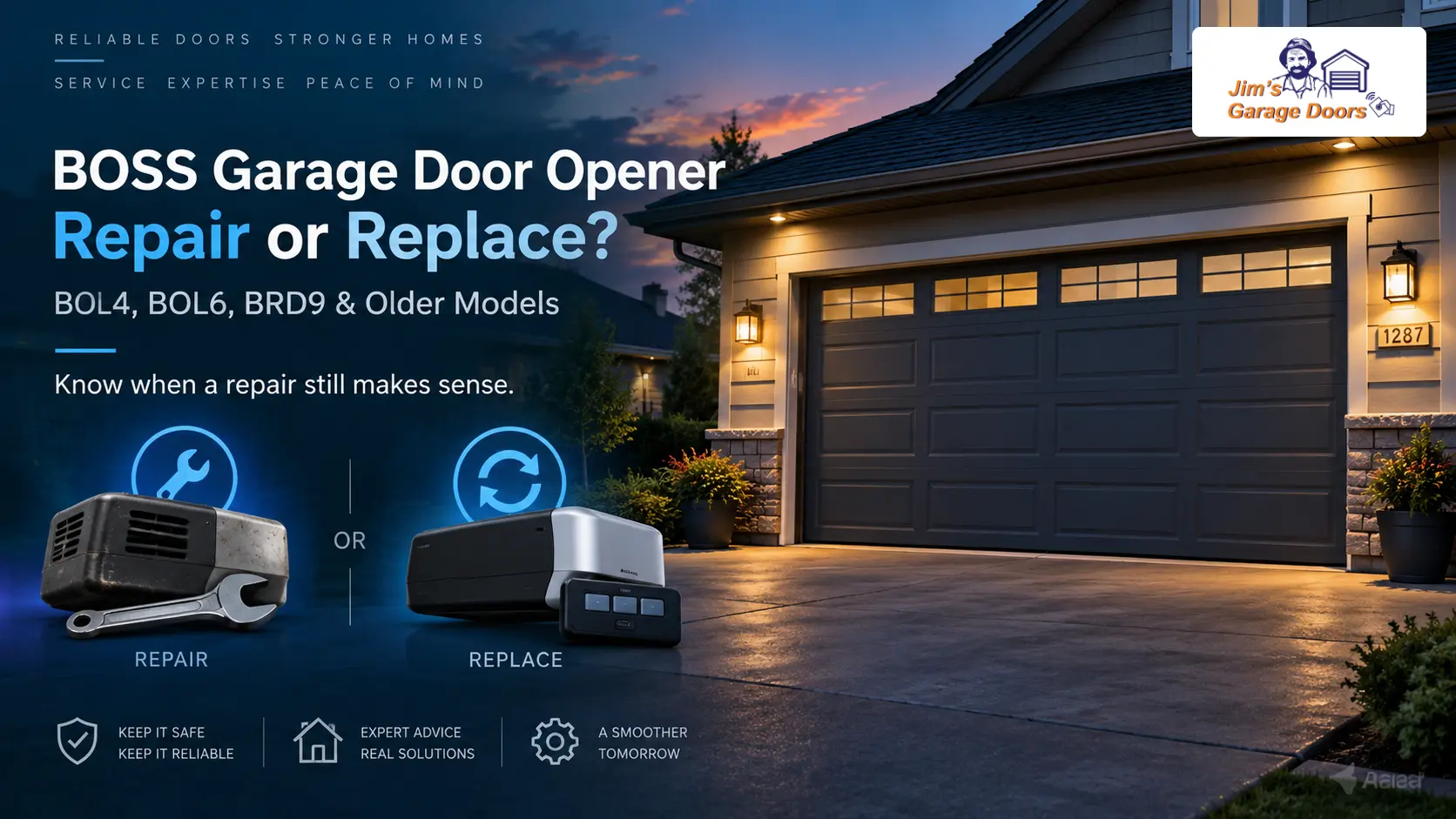
Is an Older BOSS Garage Door Opener Worth Repairing?
Yes, an older BOSS opener can still be worth repairing when the fault is isolated, and the remaining opener and garage door are in serviceable condition.
Jim’s Garage Doors currently treats opener repair and replacement as a diagnosis-led decision. Repair may be appropriate when the failed component can be corrected, the opener still suits the garage door, and reliable operation can reasonably be restored.
Repair deserves consideration when:
- the problem is limited to one component or control system;
- the opener was otherwise operating reliably;
- the garage door itself is balanced and mechanically sound;
- compatible parts or controls remain practical; and
- no other significant faults are developing at the same time.
The key point is that age alone is not a diagnosis.
A tenured opener with one repairable control fault can be a better repair candidate than a newer opener with repeated motor and drive problems.
Which BOSS Opener Faults Are Often Worth Assessing for Repair?
Remote, receiver, control, travel, and some drive-related problems may justify repair before you consider a full opener replacement.
Examples include:
- a remote that has lost programming;
- a failed or incompatible handset;
- an isolated receiver or wall-control problem;
- travel behaviour that needs diagnosis;
- an opener that has become disengaged;
- a drive connection problem; or
- another single opener fault where the rest of the system is sound.
Jim’s Garage Doors specifically diagnoses remote problems, drive issues, travel faults and control faults before determining whether an opener needs replacement.
If the fault appears limited to the handset, programming or receiver system, use our BOSS Garage Door Remote Programming & Replacement Guide before considering complete opener replacement.
Is the Garage Door Causing the BOSS Opener Problem?
It can be. A heavy, crooked or resistant garage door can make a serviceable opener appear faulty because the motor is being asked to move excessive weight or friction.
Check the garage door before condemning the opener.
Possible door-side problems include:
- broken or weakened springs;
- damaged or displaced cables;
- binding rollers;
- track resistance;
- poor balance; and
- uneven movement.
Jim’s Garage Doors notes that springs, cables, rollers, tracks and door balance can all affect opener performance, and that an opener should not be expected to compensate for a damaged or difficult-to-move door.
If the door is unusually heavy, hangs crooked or moves unevenly, repair the mechanical door fault first.
Replacing the motor without correcting the door can leave the original cause untouched.
If you have not yet isolated the fault, work through our BOSS Garage Door Opener Troubleshooting Guide before deciding whether the opener itself needs repair or replacement.
When Does Replacing an Older BOSS Opener Make More Sense?
Replacement becomes more reasonable when the opener has major or repeated faults and repairing one component is unlikely to restore dependable operation.
Replacement deserves stronger consideration when:
- the motor has failed;
- drive faults keep returning;
- receiver or control problems occur alongside other opener faults;
- compatible remotes or controls are increasingly difficult to maintain;
- the opener repeatedly stops, strains or operates inconsistently;
- the opener is no longer suitable for the garage door; or
- several desired upgrades would otherwise need to be added separately.
Jim’s Garage Doors lists failed motors, old or unreliable openers, remote-compatibility problems and unsuitable opener systems among circumstances where replacement may be considered.
Does the Age of a BOL4, BOL6 or BRD9 Mean It Should Be Replaced?
No. The model’s age or generation should inform the decision, but it should not determine it by itself.
Steel-Line documentation still identifies OL4/BOL4, OL6/BOL6, OL6.5/BOL6.5 and RD9/BRD9 families that may carry BOSS or Guardian branding.
For an older opener, assess:
- present reliability;
- frequency of recent faults;
- motor and drive condition;
- availability of compatible controls;
- condition of the garage door; and
- whether the opener still provides the functions required.
An older BOL6 that still operates reliably, apart from one remote issue, presents a very different decision than an opener with repeated drive, receiver, and travel faults.
Condition is more useful than the model name alone.
Should You Repair the Receiver or Replace the Whole Opener?
Repairing the receiver can make sense when the radio-control problem is isolated, and the motor and drive remain dependable.
For example, if every handheld remote stops working but the wired wall control still operates the garage door normally, the fault may be concentrated in the receiver or remote-control system.
That does not automatically justify replacing the complete opener.
However, the decision changes when receiver problems occur alongside:
- unreliable motor operation;
- repeated drive faults;
- persistent travel problems;
- abnormal opener noise; or
- other recurring control failures.
In that situation, fixing the receiver may solve only one problem within an increasingly unreliable opener.
What Should a Replacement Opener Provide?
A replacement opener should suit the garage door and address the reasons for replacement, not just be a newer motor.
Jim’s Garage Doors states that opener selection depends on the door’s type, size, weight, balance, movement and installation space.
When replacing an older BOSS opener, check:
- Correct door type: roller, sectional and suitable tilt doors require appropriate opener configurations.
- Suitable operating capacity: match the opener to the actual door rather than compensating for poor balance.
- Smooth operation: noise and movement characteristics matter where garages adjoin bedrooms or living spaces.
- Safety compatibility: choose a system compatible with the safety equipment required for the installation.
- Accessible remotes and controls: consider future handset and accessory availability.
- Smart-access requirements: if you want phone control or monitoring, consider it during opener selection, not as an afterthought.
If your existing BOSS opener remains reliable and only lacks phone control, a compatible retrofit may be more practical than replacement. See our BOSS Garage Door Opener Smart Upgrade Guide for compatibility and retrofit requirements.
BOSS Garage Door Opener Repair or Replace: What Does Your Situation Suggest?
Repair generally makes more sense for an isolated fault; replacement becomes more relevant as major faults, compatibility problems and reliability concerns accumulate.
| Situation | More Appropriate Next Step |
|---|---|
| One remote fails but another works | Check battery, programming or replace handset |
| All remotes fail but wall control works | Diagnose receiver/control system |
| One isolated opener fault | Assess repair |
| Door is heavy, crooked or binding | Repair garage door first |
| Motor and drive remain reliable | Repair may remain practical |
| Motor or drive faults keep recurring | Compare opener replacement |
| Reliable opener only lacks smart control | Consider compatible retrofit |
| Several faults occur together | Replacement becomes more relevant |
| Opener no longer suits the door | Assess suitable replacement system |
This table is a decision framework, not a diagnosis. The opener and garage door still need to be assessed together.
When Should a BOSS Opener Be Professionally Assessed?
Professional assessment is appropriate when the fault cannot be isolated safely, the garage door is mechanically damaged or several opener problems are occurring together.
An inspection is particularly useful when:
- the motor runs, but the door does not move normally;
- the opener repeatedly strains or stalls;
- the door is unusually heavy or uneven;
- receiver or remote faults keep returning;
- abnormal drive noise is present; or
- you are deciding between a major repair and a full replacement.
The diagnosis should identify whether the problem is in the garage door, controls, receiver, drive, or motor before recommending replacement.
This prevents replacing an opener when the real issue is elsewhere in the system.
Repairing or Replacing a BOSS Garage Door Opener?
The right decision starts with identifying what has failed, not replacing an older BOSS opener simply because of its age.
If the fault is isolated, the garage door is mechanically sound, and the opener can reasonably return to reliable operation, repair may still be practical.
If the opener has repeated motor, drive, or control faults, compatible components are becoming impractical, or several upgrades are needed at the same time, replacement is worth considering.
Jim’s Garage Doors can inspect the garage door and opener together, identify whether the fault is in the door, controls, receiver, drive or motor, and determine the appropriate next step.
Call Jim’s Garage Doors on 131 546 or request a quote to arrange an opener and garage door assessment.