
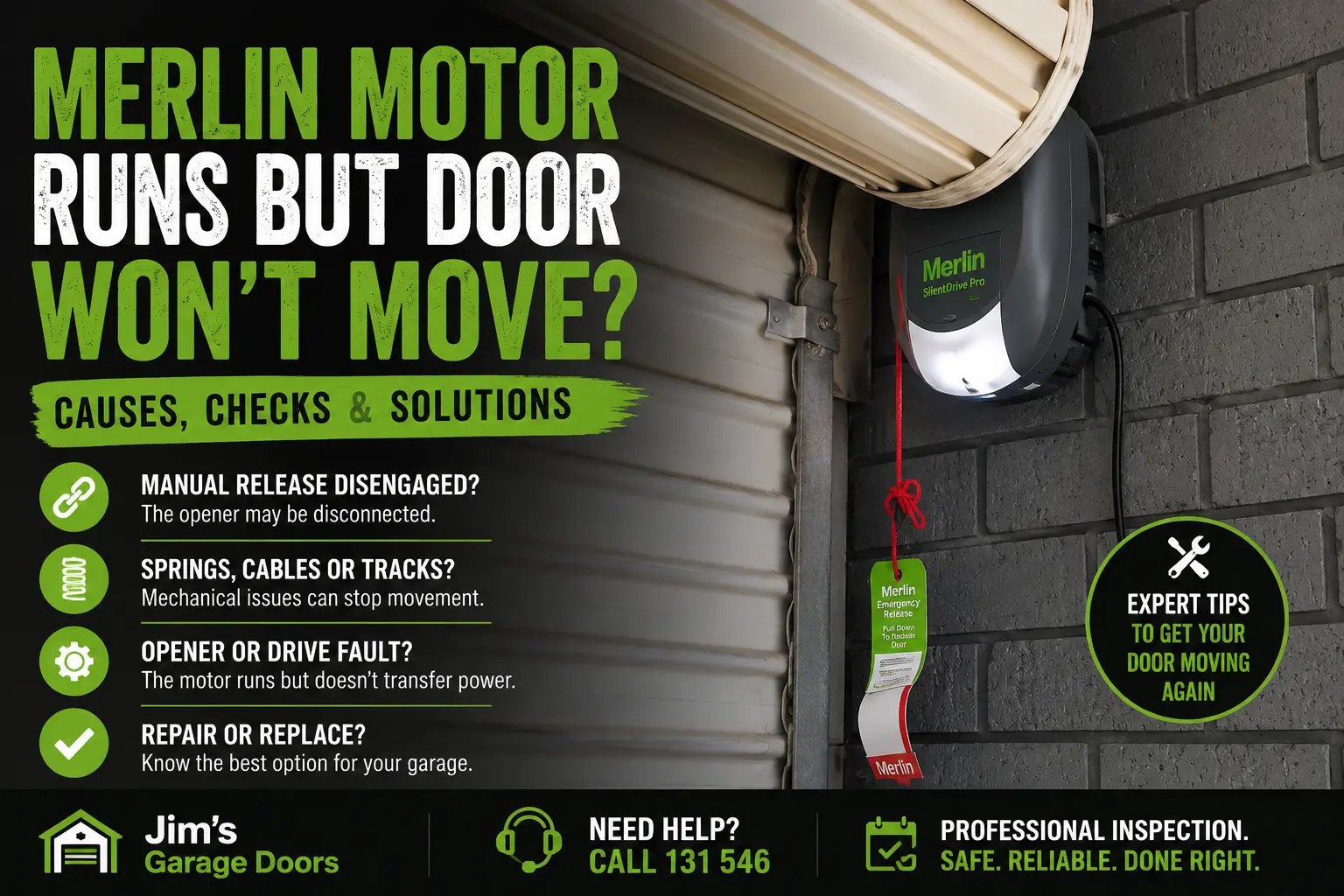
A Merlin garage door motor that runs while the door stays still is commonly disengaged from the door, unable to transfer movement through the trolley or drive system, or trying to move a door with a spring, cable, track or balance fault. Check whether the manual release has been activated and watch which parts move during one controlled test.
Stop using the opener if the door is crooked, unusually heavy, jammed, off-track or has a loose cable or damaged spring. Continuing to operate the motor against a mechanical fault can damage the opener, door arm, rail or door hardware.
For sectional and tilt doors, the rail, belt or chain may move while the door remains disconnected from the trolley. For roller doors, the opener may remain disengaged or its drive may no longer transfer movement to the curtain.
What Should You Check First?
Watch the opener during one controlled test and note exactly what moves. The sound alone cannot confirm whether the fault is in the opener or the garage door.
| What You Observe | More Likely Cause | First Action |
|---|---|---|
| Motor sounds active but nothing along the rail moves | Internal opener or drive fault | Stop repeated testing and arrange opener inspection |
| Belt or chain moves but the door stays still | Trolley or door connection is disengaged | Check whether the manual release was used |
| Trolley moves but does not pull the door | Door arm, bracket, trolley or carriage fault | Stop use until the connection is inspected |
| Roller-door motor runs, but the curtain stays still | Disengaged opener or failed drive connection | Check the model-specific release position |
| Motor hums and stops without movement | Locked door, mechanical jam, excessive door weight or internal motor-start fault | Stop operating and inspect for visible door damage |
| Door moves a few centimetres, then stops | Binding track, damaged roller, spring fault or excessive load | Watch where movement stops and arrange inspection |
| Door is crooked, heavy or has a hanging cable | Spring, cable, track or roller fault | Stop use immediately |
Why Can the Merlin Motor Run Without Moving the Door?
The Merlin motor moves the garage door through an engagement and drive system. The opener can make an operating sound without moving the door when that connection has been released, disconnected, worn or damaged.
The cause usually belongs to one of four groups:
- Manual-release issue: The opener was disengaged during a blackout or manual operation and did not reconnect.
- Trolley or drive issue: The rail mechanism moves, but the trolley, carriage, door arm or drive component does not transfer movement to the door.
- Garage-door fault: A spring, cable, roller, track or lock prevents the door from moving safely.
- Internal opener fault: The motor receives a command but cannot transfer rotation through the internal drive.
The first useful distinction is whether movement reaches the rail, trolley, door arm or roller-door curtain.
Step 1: Check Whether the Manual Release Is Disengaged
A Merlin opener may operate without moving the door because the manual release has disconnected the motor from the door mechanism. This often follows a blackout or an attempt to operate the door by hand.
Merlin states that its garage-door openers have a manual-release cord. It also warns that an open door may fall rapidly when springs are weak or broken, and that the release cord must not be used to lift the door.
Before Checking the Release
Do not touch the release mechanism unless:
- The door is fully closed
- The door is level and stable
- No spring has a visible gap
- No cable is loose, frayed or hanging
- No roller has left the track
- The door does not appear jammed or unsupported
Do not release a partly open, crooked or unusually heavy door.
Reconnecting a Sectional or Tilt-Door Opener
Merlin’s current homeowner support guidance shows a re-engagement control near the release cord for its sectional and tilt-door instructions. The exact trolley design and operating sequence can differ between models, so identify the opener and check its manual before attempting to reconnect it.
Use this process:
- Confirm that the door is fully closed and stable.
- Locate the model number on the motor housing.
- Open the matching Merlin manual or homeowner instructions.
- Follow the stated re-engagement sequence.
- Run one controlled test using the wall control or remote.
Do not force the trolley, carriage or door arm into position.
Reconnecting a Merlin Roller-Door Opener
Merlin roller-door openers also use model-specific release and re-engagement instructions. Merlin’s current homeowner page describes using the release cord for its roller-door guidance, but the opener label and manual should be checked before operating the mechanism.
If the opener is correctly engaged but the motor still runs without moving the curtain, stop testing it. The fault may sit in the release assembly, opener drive or roller-door mechanism.
What If the Rail Moves but the Door Does Not?
If the belt, chain or trolley moves while the door remains stationary, the fault is usually between the rail mechanism and the door. The trolley may still be disengaged, or the carriage, door arm or mounting bracket may be loose or damaged.
Watch from a safe position during one test:
- Does the belt or chain move?
- Does the trolley travel along the rail?
- Does the trolley pass the door connection without engaging?
- Does the door arm move?
- Is the arm attached at both ends?
- Does the rail flex, shake or make an impact noise?
Stop operating the opener if the door arm is disconnected, a bracket is loose, or the trolley strikes the motor or rail end. Keep hands clear of the trolley, belt, chain, rail joints and door arm.
Step 2: Check Whether the Door Is Locked or Jammed
A locked or jammed garage door can prevent movement while the motor continues trying to operate.
Check for:
- A manual slide lock that remains engaged
- A padlock or external locking device
- A roller pressed tightly against the track
- A sectional panel caught near a hinge
- A roller-door curtain rubbing inside one guide
- Debris inside a guide or track
- A bent or displaced track
- A bottom seal stuck to the floor
- An object wedged against the door
Do not keep pressing the control when the door is locked. The opener may pull against the lock, door arm, rail or curtain without moving the door.
Arrange an inspection if operating against a lock has bent a bracket, displaced hardware or caused a sharp impact.
Step 3: Check for Broken Springs or Cable Problems
A Merlin opener may sound active while the door stays still because a spring or cable fault has made the garage door too heavy or uneven for the motor to move.
Stop operating the door if you notice:
- A visible gap in a torsion spring
- A spring hanging loosely
- A cable that is frayed, slack or off its drum
- One side of the door sitting lower than the other
- A loud bang before the fault started
- The top panel bending as the opener pulls
- The motor straining while the door barely moves
- The door lifting on one side only
Do not refit a cable, tension a spring or attempt to straighten a crooked door. Springs, cables and bottom brackets can remain under significant tension.
Merlin advises owners to stop using an opener when the door stops, bounces, grinds, scrapes or no longer moves smoothly.
Can You Test the Garage Door Manually?
Test the door manually only when it is fully closed, stable and free from visible spring, cable, roller or track damage. This test can help separate a door fault from an opener fault.
If the door appears safe:
- Switch off the opener.
- Follow the model instructions to disengage it.
- Lift the door slowly using its fitted handle.
- Keep both hands clear of tracks, rollers and hinges.
- Stop if the door is heavy, crooked, rough or difficult to control.
The door should move without severe resistance, dropping or twisting. Stop the test if you cannot control its weight with both hands. Do not attempt to judge or adjust spring tension yourself.
Merlin warns against pulling the door with the release cord and against releasing an open door where weak or broken springs may allow rapid movement.
Step 4: Check the Tracks, Rollers and Door Position
A door may remain stationary or move only a short distance when a roller, hinge, panel or track creates a hard stopping point.
Inspect from inside the garage while the door is closed:
- Are both tracks straight and firmly mounted?
- Is a roller outside the track?
- Is a sectional-door hinge damaged?
- Is one panel sitting out of position?
- Does a roller-door curtain sit evenly between its guides?
- Is anything lodged in a guide or track?
- Are there fresh scrape marks near the stopping point?
- Did the door become noisy before it stopped moving?
Do not loosen track brackets, hinges or loaded door parts. A displaced track, escaped roller or crooked door requires on-site repair.
Does the Door Move but Fail Only During Closing?
If the Merlin opener can move the garage door but the problem occurs specifically while closing such as stopping, reversing or reopening after reaching the floor use our Merlin garage door won’t close or keeps reversing guide. That fault is more likely to involve Safety IR Beams, closing resistance or travel limits than a complete loss of drive movement.
Step 5: Identify the Type of Sound
A steady operating sound, a low hum and a grinding noise point to different fault groups. Listen during one controlled attempt rather than repeatedly activating the opener.
Motor Sounds as Though It Is Running
A steady motor sound with no door movement often means the opener is active, but movement is not reaching the door.
Possible causes include:
- Disengaged manual release
- Trolley or carriage fault
- Loose door arm or mounting bracket
- Roller opener remaining disengaged
- Internal drive component not transferring movement
Motor Hums but Does Not Turn the Drive
A hum followed by a stop can indicate:
- Locked or jammed door
- Door that has become too heavy
- Internal motor-start, drive or control fault
- Opener overload caused by mechanical resistance
Do not repeatedly activate a humming opener. Switch it off and arrange testing if no simple obstruction is visible.
Grinding, Clicking or Impact Noise
Grinding, repeated clicking or a sharp impact can indicate a worn drive part, a trolley striking the rail end or the opener pulling against a locked or jammed door.
Stop use when the sound is new, harsh or accompanied by little or no movement.
Is the Merlin Opener Also Flashing?
A running or humming motor may also be accompanied by warning lights when the opener detects resistance, overload or another operating fault. If the Merlin opener is flashing during the failed movement, use our Merlin garage door opener flashing lights guide to interpret the visual warning alongside what the motor and door are doing.
If the Merlin motor does not respond at all when the handheld remote is pressed but still operates from the wall control, the problem is different from a drive fault. Use our Merlin garage door remote not working guide for battery, programming, signal and receiver checks.
What Do People Commonly Misdiagnose?
The common mistake is assuming that a running motor proves the opener is working and the garage door is the only problem. A motor can make its usual sound while a trolley, belt, chain, gear, carriage or door connection fails to transfer movement.
The opposite mistake also occurs. A broken spring, displaced cable, locked door or escaped roller can make a working opener appear defective.
Before replacing the motor, determine:
- Whether movement reaches the rail or roller-door drive
- Whether the opener is engaged
- Whether the door can move safely by hand
- Whether the springs, cables, tracks and rollers remain intact
- Whether the trolley and door arm are connected
Can a Power Cycle Fix the Problem?
A single power cycle may clear a temporary electronic issue, but it cannot reconnect a trolley, repair a spring, release a locked door or restore a failed drive component.
Try it once only when:
- The door is closed and stable
- There is no visible mechanical damage
- The opener appears correctly engaged
- The door is not locked or jammed
Switch the opener off at the power point, wait about one minute, restore power and run one controlled test.
Merlin states that its garage-door openers do not have one simple reset process for every fault. Model-specific guidance or professional assessment may be required.
Stop DIY Checks Immediately When You See These Signs
Stop operating the opener and arrange an inspection when:
- The door is crooked or off-track
- A spring has a visible gap or hangs loosely
- A cable is frayed, slack or detached
- One side lifts while the other remains down
- The top panel bends when the opener pulls
- A roller has left the track
- The rail, trolley or door bracket moves abnormally
- The motor grinds, strikes or repeatedly clicks
- The door drops during manual operation
- The opener will not remain connected to the door
Do not dismantle the motor, rail, spring system, cables, bottom brackets or roller-door drum.
What Does a Technician Check?
A technician should inspect the garage door before deciding that the Merlin motor has failed. The inspection separates a door-mechanism fault from an opener-drive fault.
The assessment may include:
- Manual-release and re-engagement operation
- Belt, chain, rail, trolley and carriage movement
- Door arm and mounting brackets
- Roller-opener engagement and drive transfer
- Door locks and obstructions
- Track and roller condition
- Spring condition and door balance
- Cable condition and alignment
- Motor and internal drive operation
- Travel limits and learning cycle
- Safety reversal response
- Opener suitability for the door
Merlin maintains support material for current and legacy opener models, so the model should be identified before programming controls or ordering parts.
What If the Merlin Garage Door Will Not Open at All?
A motor that runs without moving the door is one specific cause of a Merlin garage door failing to open. If the opener does not respond normally, the wall control and remote also fail, or the cause is still unclear, use our Merlin garage door not opening guide to troubleshoot the wider opener, control and garage-door system.
Merlin Garage Door Opener Repairs
If the motor runs but the door does not move after the opener has been correctly re-engaged, the fault may involve the trolley, drive system, door arm, springs, cables, tracks or the opener itself.
Jim’s Garage Doors provides garage door opener repairs and replacement services for Merlin and other major brands. A technician can inspect the complete door and opener system before recommending repair or replacement.
Door heavy, crooked or making grinding noises?
Do not keep operating the Merlin opener. Call Jim’s Garage Doors on 131 546 or request a quote for an on-site inspection.
Frequently Asked Questions
Why can I hear my Merlin motor running but the door does not move?
The opener may be disengaged from the door, or the trolley, carriage, door arm or internal drive may not be transferring movement. Check whether the manual release was used and watch which parts move during one controlled test.
How do I know whether my Merlin opener is disengaged?
On a sectional or tilt door, the rail mechanism may move without pulling the door. On a roller door, the motor may operate while the door remains disconnected from its drive. Use the instructions for the exact Merlin model.
Can I reconnect the Merlin opener myself?
Follow Merlin’s homeowner instructions only when the door is fully closed, stable and free from visible spring, cable, roller or track damage. Do not operate the manual release on an open, crooked or jammed door.
Can a broken spring cause the motor to run without lifting the door?
Yes. A broken or weak spring can make the door too heavy for the opener. Stop using the motor if the door feels heavy, lifts unevenly, has a loose cable or stops after a loud bang.
Why does the Merlin motor hum but not move the door?
A hum can indicate a locked or jammed door, excessive door weight or an internal motor-start, drive or control fault. Do not keep activating the opener if the cause is not visible.