
A Steel-Line sectional door and a Steel-Line roller door can both provide reliable garage access, but they use the available space very differently.
A sectional garage door moves along tracks and stores horizontally beneath the garage ceiling. A roller door rolls into a curtain above the opening. The better choice depends on your garage layout, available headroom and side room, appearance preferences, insulation needs and how you plan to automate the door.
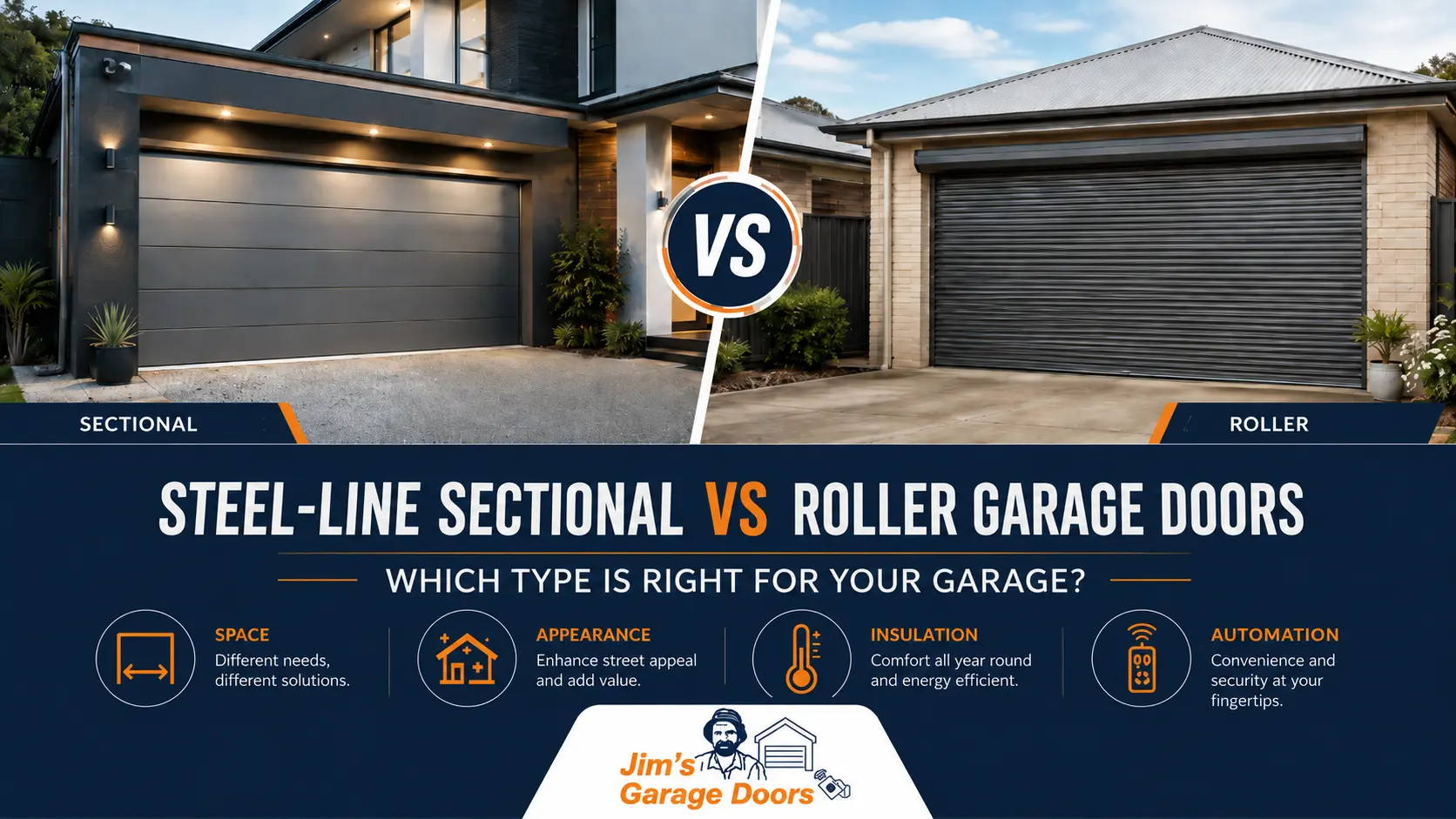
Steel-Line Sectional vs Roller Doors at a Glance
| Decision factor | Steel-Line Sectional Door | Steel-Line Roller Door |
|---|---|---|
| How it opens | Panels travel along tracks beneath the ceiling | Curtain rolls around a drum above the opening |
| Best suited to | Homes prioritising appearance, finish options and insulation | Garages prioritising simplicity and efficient use of space |
| Ceiling use | Requires overhead tracks | Does not run across the ceiling |
| Headroom | Requires space for tracks and door movement | Requires space above the opening for the rolled curtain |
| Appearance options | Wide range of panels, finishes and styles | Simpler ribbed curtain design with colour options |
| Insulation | Insulation options are available | Less suited to panel-style insulation |
| Automation | Can be automated | Can be automated |
| Main advantage | Design flexibility | Simple, compact operating system |
Neither design is automatically better. The right choice depends on what matters most in the individual garage.
How Does a Steel-Line Sectional Garage Door Work?
A Steel-Line sectional garage door is made from hinged horizontal panels that move vertically before travelling along tracks beneath the garage ceiling. This allows the door to open without swinging outward into the driveway.
Steel-Line describes sectional doors as its modern garage-door option, with a broad range of materials, colours, designs and styles. The company also offers features such as FingerProof™ panel design, weather seals and compatible insulation products.
A sectional door generally suits homeowners who place greater importance on:
- architectural appearance;
- panel and finish selection;
- insulation options;
- smooth automated operation;
- creating a garage door that forms part of the home’s facade.
The main spatial consideration is the track system. The door needs room to travel back underneath the ceiling.
How Does a Steel-Line Roller Garage Door Work?
A Steel-Line roller door uses a flexible steel curtain that rolls around a drum above the garage opening rather than travelling across the ceiling.
This makes the operating system relatively compact and leaves most of the ceiling area free.
Steel-Line positions its roller doors as a space-saving, cost-effective and reliable option. Its current residential roller-door range also supports automatic openers and uses a bottom rail with a weather seal.
A roller door is often worth considering when the homeowner prioritises:
- simple operation;
- keeping the ceiling area relatively clear;
- a traditional garage-door format;
- practical access rather than extensive panel styling.
However, the rolled curtain still requires adequate room above and beside the garage opening.
Which Door Uses Garage Space More Efficiently?
A roller door keeps the ceiling area clearer, while a sectional door can use the space directly above the opening more effectively, depending on the garage dimensions.
That is why “roller doors save more space” isn’t always enough information to make the decision.
A sectional door needs tracks extending back into the garage ceiling area. This may matter where ceiling-mounted storage, lighting, equipment or other installations occupy that space.
A roller door avoids those horizontal tracks, but the curtain must roll into a drum above the opening. Steel-Line’s roller-door technical information shows that headroom and side-room requirements vary by door series and whether an automatic operator is installed.
The practical question is therefore:
Which Looks Better on the Front of a Home?
A Steel-Line sectional door usually provides greater design flexibility because it’s built from individual panels that can be offered in different profiles, materials, colours, and finishes.
Steel-Line describes sectional doors as available in a wide range of design and material options, making them particularly relevant when the garage door is a major visual feature of the home’s facade.
Roller doors have a more consistent curtain-style appearance.
That does not make them unattractive. It simply means the choice is usually more practical than architectural.
A useful distinction is:
- Choose sectional when the garage door is part of the home’s design statement.
- Consider roller when simple appearance and practical operation matter more than panel styling.
Once you choose the door type, colour and profile become the next major appearance decisions. Our guide to Steel-Line garage door colours, profiles and finishes covers current Colorbond® shades, Matt finishes, timber-look options and how different profiles affect the finished facade.
Which Is Better if You Want an Insulated Garage Door?
A Steel-Line sectional garage door is the clearer choice when insulation is an important requirement.
Steel-Line offers Mammoth® garage-door insulation for its standard sectional garage doors. The insulation is designed to reduce heat transfer through the door and can be combined with brush seals for improved performance.
This can matter depending on where the garage is:
- attached to living areas;
- used as a workshop;
- used regularly for hobbies or exercise;
- affected by significant heat or cold;
- being considered as part of the home’s thermal envelope.
If the garage is primarily used for vehicle storage and insulation is not a priority, this advantage may carry less weight.
Can Both Steel-Line Sectional and Roller Doors Be Automated?
Yes. Steel-Line offers automatic opener systems for both sectional and roller garage doors.
Sectional-door openers can include features such as soft start and stop, auto reverse, digital limits and manual release. Steel-Line also offers compatible smart-control options for selected systems.
Roller-door opener systems are also available, including models with soft operation, electronic limits, reversing systems and manual disengagement.
If you already have a Steel-Line automatic opener that isn’t operating correctly, diagnose the problem before selecting a new motor. See our guide to Steel-Line garage door opener troubleshooting, repair and upgrade options for remote, power, sensor, engagement and travel-limit faults.
Automation therefore does not usually decide the sectional-versus-roller question on its own.
The better approach is to choose the door system that suits the garage first, then select an opener compatible with the door’s size, weight and configuration.
What Most Homeowners Get Wrong About Sectional vs Roller Doors
The common mistake is choosing the door type based only on the amount of visible space above the garage opening.
Both systems have spatial requirements.
A roller door needs sufficient room for:
- the rolled curtain;
- brackets and supporting hardware;
- side clearance;
- additional space for an automatic opener.
A sectional door needs:
- side tracks;
- overhead tracks;
- suitable ceiling clearance;
- an installation path that does not conflict with other garage fixtures.
The correct comparison should therefore consider the whole garage volume, not just the lintel above the opening.
Are Sectional Doors Harder to Maintain Than Roller Doors?
Sectional doors have more individual moving interfaces because the system includes hinged panels, rollers, and tracks, while roller doors use a curtain, guides, and a counterbalance system. Both still require periodic inspection and maintenance.
Steel-Line’s own documentation notes that garage doors are moving mechanical products and require periodic servicing. It also warns that qualified personnel should carry out spring and cable repairs.
For the homeowner, the important distinction is not which door is “maintenance-free.”
Neither is.
The better question is whether the door remains:
- balanced;
- aligned;
- smooth during movement;
- free from abnormal noise;
- free from visible damage.
Which Steel-Line Garage Door Should You Choose?
Choose based on the garage layout and the homeowner’s priorities rather than assuming one door type is universally better.
| Situation | Better starting point | Reason |
|---|---|---|
| Appearance is a major priority | Sectional | More panel, material and finish flexibility |
| Insulation is important | Sectional | Dedicated insulation options are available |
| Ceiling space needs to stay clearer | Roller | Curtain rolls above the opening instead of travelling across the ceiling |
| Simple, practical operation is the priority | Roller | Straightforward curtain-and-guide design |
| Garage door forms a major part of the facade | Sectional | Greater architectural flexibility |
| Garage has unusual clearance constraints | Measure before deciding | Either system may be limited by headroom, side room or ceiling layout |
| Automatic operation is required | Either | Both systems can be automated |
The most important step is measurement.
A door that looks ideal in a brochure may not be the best fit once you consider the actual opening height, opening width, headroom, side room, and ceiling layout.
Need Help Choosing Between a Steel-Line Sectional and Roller Door?
If you are choosing a new or replacement Steel-Line garage door, start with the garage itself.
Jim’s Garage Doors can assess the opening, available clearances and intended use of the garage to help determine whether a sectional or roller-door configuration is the better fit.
For homeowners who prioritise design flexibility and insulation, a sectional door will often be the stronger starting point.
For garages where simple operation and keeping the ceiling area clear matter more, a roller door may make more sense.
The final choice should follow the measurements and the way the garage will actually be used.