
A Steel-Line garage door that will not open, refuses to close, stops halfway, or reverses unexpectedly may have an opener/control fault or a mechanical problem with the door.
The first step is to identify which side of the system is causing the problem. Check simple issues such as power, remotes, obstructions and safety sensors first.
If the door is heavy, crooked, binding, off-track or has a damaged spring or cable, stop operating it and arrange professional assessment.
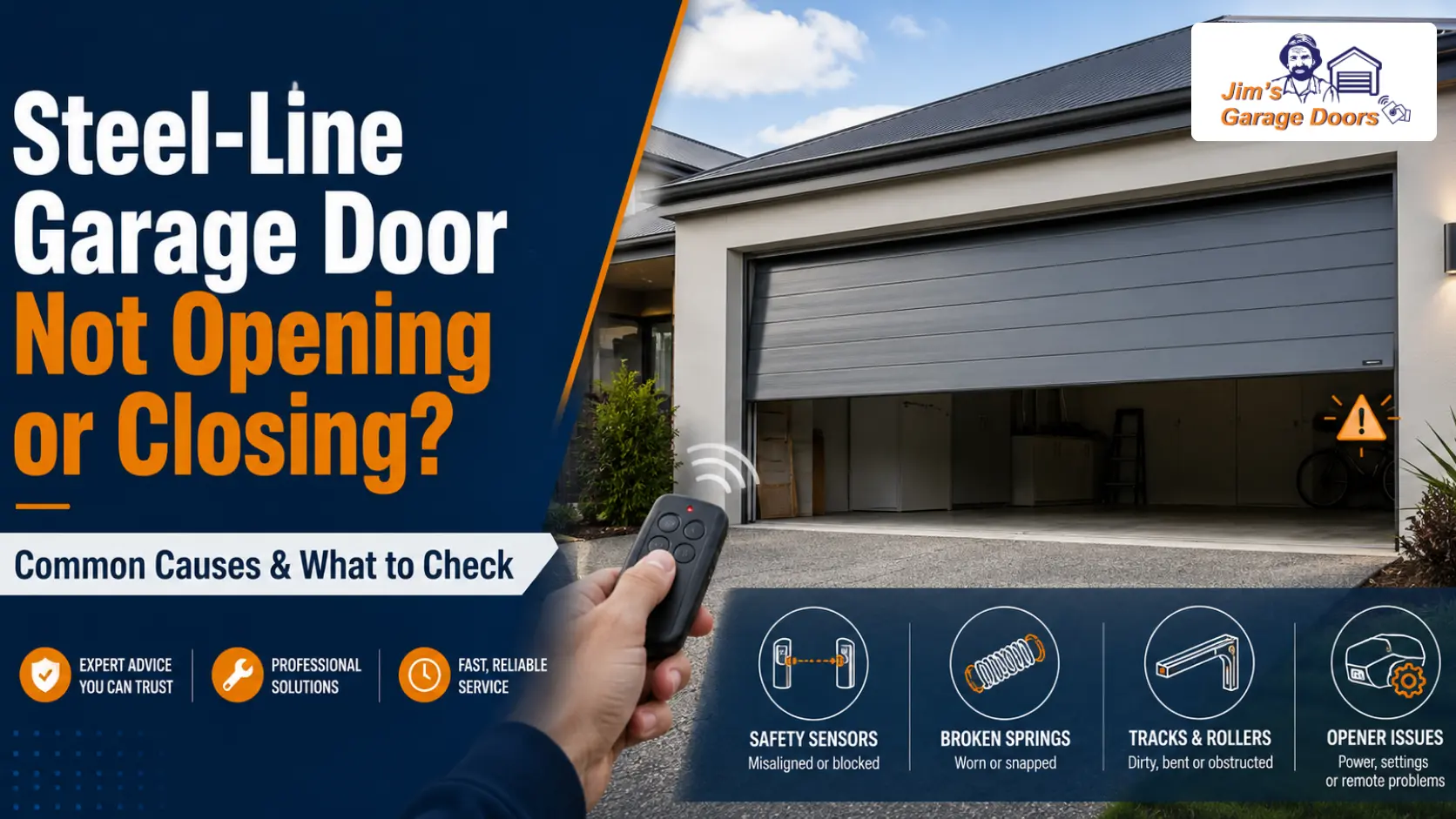
Steel-Line Garage Door Problems at a Glance
| What the door is doing | Likely area to check | First action |
|---|---|---|
| Nothing happens when the remote is pressed | Remote, battery or opener power | Try another control and check power |
| Motor runs but the door does not move | Manual release or opener engagement | Check whether the opener is engaged |
| Door begins closing then reverses | Obstruction, sensors or resistance | Clear the doorway and check sensors |
| Door stops at the same position | Travel limits, obstruction or binding | Observe exactly where it stops |
| Door feels unusually heavy | Spring or balance system | Stop operation and arrange assessment |
| Door moves unevenly or becomes crooked | Cable, track, roller or balance fault | Stop repeated operation |
| One remote works but another does not | Remote battery or coding | Test the affected transmitter |
The symptom helps narrow the fault, but it does not confirm which component has failed.
Is the Problem the Steel-Line Door or the Garage Door Opener?
The quickest diagnostic distinction is whether the physical garage door can move normally without relying on the opener. A functioning opener cannot properly compensate for a heavy, binding, crooked or mechanically unstable door.
Before treating the motor as the problem, visually check that the door stays correctly positioned in its tracks, the spring system appears intact, and nothing obstructs normal movement.
Where the door appears mechanically stable, and the system permits safe manual operation, disengaging the opener can help separate the two sides of the system.
If the door moves smoothly by hand but not automatically, the opener or controls are more likely to be the issue.
If the physical door moves normally but automatic operation does not, continue with our dedicated Steel-Line garage door opener troubleshooting guide for power, remote, safety-sensor, engagement, and travel-limit checks.
If the door remains heavy, catches, tilts or will not travel normally, the physical door requires investigation.
Do not disengage or manually operate a door that appears unstable, crooked or affected by a broken spring or cable.
Why Does Nothing Happen When You Press the Steel-Line Remote?
If nothing happens when you press the remote, check the remote battery, transmitter operation, wall control and opener power supply before assuming the motor has failed.
A useful first test is whether another control can operate the door.
If another remote or the wall-mounted control works, the problem is more likely to involve the individual remote, battery or coding.
If none of the controls works, the fault may instead involve:
- loss of electrical power;
- the opener itself;
- control wiring;
- another part of the automatic system.
Avoid opening the motor housing or attempting electrical repairs unless appropriately qualified.
Why Does the Motor Run but the Steel-Line Door Not Move?
If you can hear the motor running but the door stays still, first check whether the garage door has been disengaged from the automatic opener.
A manual-release mechanism left disengaged can allow the motor to operate without moving the door.
This commonly occurs after a power outage or when the door has previously been operated manually.
If the door is correctly re-engaged but still does not move, repeated operation is unlikely to help.
The opener drive system or the door’s mechanical condition may require professional inspection.
Why Does a Steel-Line Garage Door Close and Then Reverse?
A Steel-Line garage door that starts closing and then reverses is commonly reacting to an obstruction, safety-sensor input or excessive resistance during travel.
Start with the simplest possibility: make sure nothing is underneath the door or interfering with its path.
Where photo-electric safety sensors are installed, check that:
- the beam is unobstructed;
- the lenses are clean;
- the sensors have not been knocked out of alignment;
- visible wiring does not appear damaged.
If the sensors appear normal, observe the door itself. Binding rollers, dirty tracks or another source of mechanical resistance can produce a similar symptom.
The key distinction is whether the opener is receiving a safety signal or the door is physically struggling to move.
Why Does the Steel-Line Door Stop Before Fully Opening or Closing?
A door that repeatedly stops at about the same point may have a travel-limit issue, but rule out obstruction and mechanical binding before changing opener settings.
Watch the door through a complete cycle and note:
- whether it stops at the same position every time;
- whether it slows or struggles before stopping;
- whether one side moves differently;
- whether there is scraping or unusual noise;
- whether it stops or actually reverses.
A consistent electronic stopping point can suggest a limit-setting issue.
A door that visibly struggles before stopping is more likely to have mechanical resistance.
Do not increase opener force simply to push a binding door through the problem. That can mask the underlying fault.
Can Dirty or Misaligned Tracks Stop a Steel-Line Garage Door?
Yes. Dirt, damage or misalignment in the track or guide system can cause a Steel-Line door to bind, scrape, stop or move unevenly.
Common warning signs include:
- catching at the same position;
- scraping or rubbing;
- jerky movement;
- rollers not travelling smoothly;
- one side lagging behind the other;
- reversal during closing.
Accessible dirt or debris can be removed carefully, but a bent, loose or incorrectly aligned track should be assessed professionally.
Avoid filling garage door tracks with grease. Heavy lubrication can collect dirt and make movement worse, not better.
Can a Broken Spring Stop a Steel-Line Garage Door From Opening?
Yes. A broken or weakened spring can make the door too heavy for normal operation and can make a functioning opener appear weak or faulty.
The spring system counterbalances much of the door’s weight. When that balance is lost, the door may:
- become suddenly difficult to lift;
- open only partway;
- drop rather than remain controlled;
- place excessive load on the opener.
A visible spring break or a major change in door weight is a reason to stop operation.
Do not attempt to adjust or repair garage door springs yourself. They operate under substantial stored tension.
Can a Cable Problem Prevent a Steel-Line Door From Opening or Closing?
Yes. A loose, damaged or broken lifting cable can cause the door to become crooked, rise unevenly, jam or stop moving normally.
Typical warning signs include:
- one side sitting lower;
- a visibly loose cable;
- damaged cable strands;
- one side rising faster than the other.
If the door becomes crooked or a cable appears damaged, stop operating it. Continued movement can increase stress on the remaining lifting and track components.
What Can You Safely Check Yourself?
Homeowner troubleshooting should be limited to simple observations and low-risk checks. Leave spring, cable, track, and internal opener repairs to a qualified garage-door technician.
Reasonable checks include:
- confirming that the doorway is clear;
- checking whether the opener has power;
- testing another remote or the wall control;
- replacing an accessible remote battery;
- checking that safety sensors are clean and unobstructed;
- looking for obvious debris in accessible tracks;
- observing whether the door stays level while moving;
- noting where the door stops or reverses.
Do not:
- adjust spring tension;
- dismantle the opener;
- repair lifting cables;
- force a crooked door;
- loosen spring hardware;
- repeatedly override a safety reversal.
These observations are most useful when they help isolate the fault before you attempt a repair.
When Should You Stop Operating the Steel-Line Garage Door?
Stop operating the garage door when it is heavy, crooked, mechanically unstable or showing visible damage to springs, cables, tracks or lifting components. Continued cycling can turn a localised fault into a larger mechanical problem.
Arrange professional assessment if:
- a spring appears broken;
- a cable is loose, frayed or broken;
- the door has moved out of its normal track position;
- one side is higher than the other;
- the door feels abnormally heavy;
- tracks or brackets appear damaged;
- the door repeatedly jams;
- the engaged opener runs without moving the door;
- basic remote, power, obstruction and sensor checks do not identify the problem.
A flat remote battery may be straightforward.
A heavy, crooked or unstable garage door is not.
If the physical door cannot move correctly, solve the mechanical problem before blaming or adjusting the opener.
Need Help With a Steel-Line Garage Door That Won’t Open or Close?
If the cause isn’t obvious after basic checks, or the Steel-Line door is heavy, crooked, jammed, or mechanically unstable, the next step is to diagnose the entire door and opener system rather than keep trying to operate it.
Jim’s Garage Doors can assess faults involving garage door springs, cables, tracks, rollers, automatic openers and general door movement to determine what is preventing normal operation.
If the door has recurring mechanical problems and replacement is becoming more practical than continued repair, the next decision is the door configuration itself. Compare Steel-Line sectional and roller garage doors by space requirements, appearance, insulation and automation before choosing a replacement system.
If the immediate fault is resolved but the door has not been professionally inspected for some time, regular garage door servicing can also help identify developing issues with balance, alignment, springs, cables, rollers and opener operation before they lead to another breakdown.