A heavy Gliderol roller door that jerks during travel, sticks in the guides, or makes the opener struggle usually has a mechanical problem involving spring tension, door balance, guide clearance, curtain alignment, or another moving component.
The main task is to determine whether the resistance comes from the roller door itself or the opener.
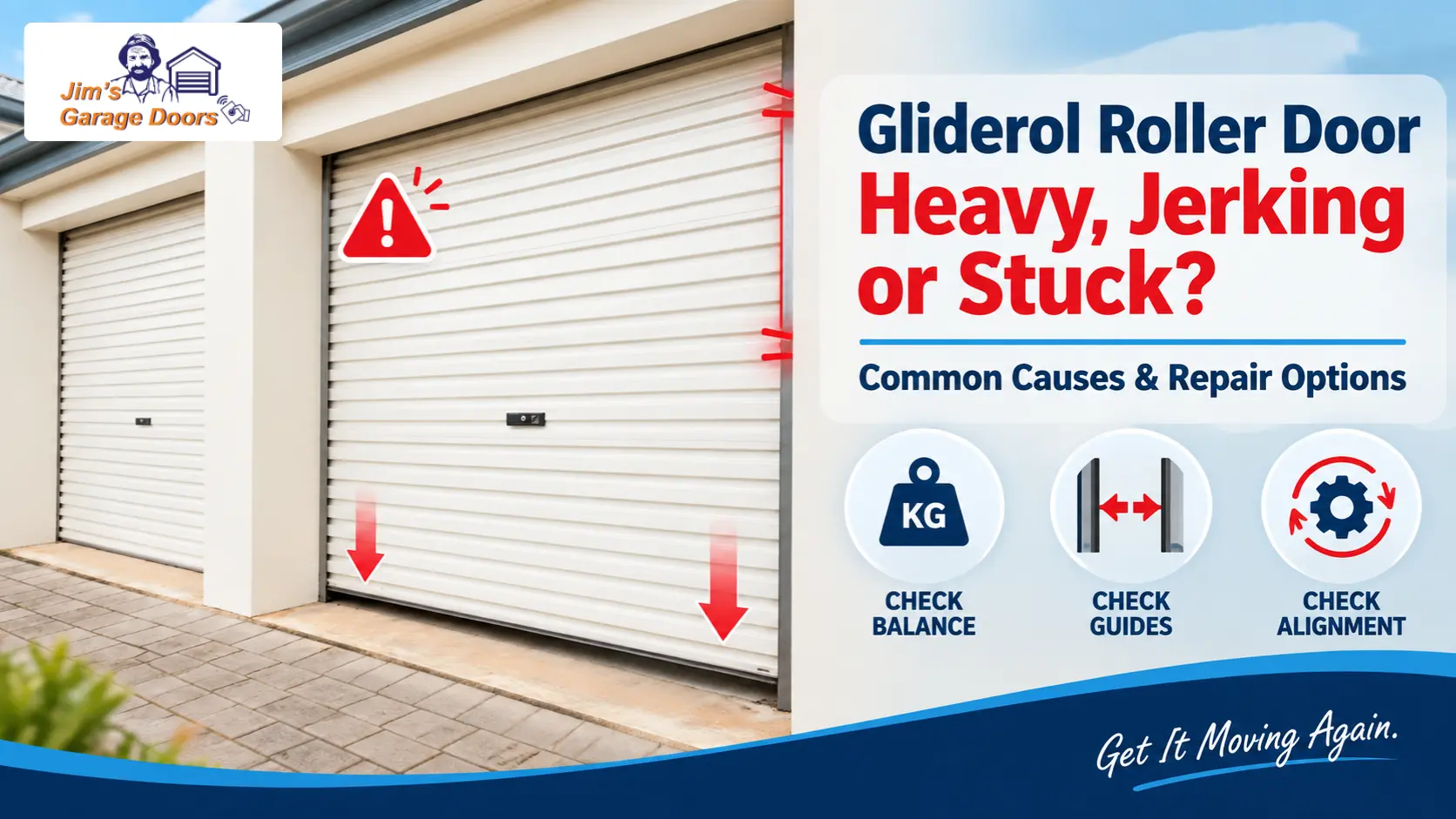
Why Is My Gliderol Roller Door Heavy, Jerking or Stuck?
A Gliderol roller door can become heavy, jerky or stuck when spring tension is incorrect, the door is out of balance, the guides are obstructed or misaligned, or the curtain is not tracking correctly.
Use the symptoms to narrow down the likely area.
| Symptom | More Likely Area | First Check |
|---|---|---|
| Door is heavy to lift manually | Spring tension or balance | Check how freely the door moves |
| Door jerks at the same height | Guide or localised binding | Inspect that section of the guides |
| Door sticks in one or both guides | Obstruction, clearance or alignment | Check for debris and visible damage |
| Door rolls up unevenly | Curtain, axle or alignment | Check whether one side rises first |
| Motor sounds strained | Mechanical resistance or balance | Compare manual and powered operation |
| Door drops when manually released | Spring tension may be too low | Stop testing if difficult to control |
Gliderol’s troubleshooting guidance identifies spring-tension problems, guide or track issues, alignment faults and worn components as possible causes of difficult or irregular operation.
Why Is My Gliderol Roller Door Heavy to Lift?
A Gliderol roller door is often heavy to lift when spring tension is too low, or the door binds as it moves through the guides.
A correctly balanced roller door should move manually without excessive effort. If lifting becomes progressively harder, or the door tends to fall when released, the spring system or door balance requires assessment.
Other signs include:
- slow opening;
- the opener sounding strained;
- the door becoming harder to operate over time;
- the curtain resisting movement in both directions.
Gliderol states that a suitably qualified technician should handle roller-door spring adjustment because the spring system is under significant tension.
Why Does My Gliderol Roller Door Jerk or Stick in the Guides?
A Gliderol roller door can jerk or stick when the curtain binds, the guides are obstructed or misaligned, or worn components create uneven resistance.
Check for:
- dirt or loose debris in the guides;
- obvious guide damage;
- uneven clearance;
- damaged seals;
- the curtain rubbing heavily on one side;
- a consistent sticking point during travel.
If the door jerks manually as well as under motor power, the fault is more likely mechanical than an opener problem.
Do not keep forcing a door through a repeated sticking point, as this can increase the load on the curtain, guides, and opener.
Why Is My Gliderol Roller Door Rolling Up Crooked?
A Gliderol roller door that rolls up crooked is usually affected by curtain alignment, axle position, bracket level or uneven tracking.
Common signs include:
- one side of the bottom rail rising before the other;
- the curtain tightening against one guide;
- the roll becoming uneven at the top;
- the door rubbing more heavily on one side.
Gliderol installation guidance identifies uneven bracket level and axle centralisation as factors that can cause a roller door to roll crooked or form an uneven roll.
If the door is visibly tracking crooked, avoid operating it repeatedly until you’ve checked the alignment.
Is the Motor Faulty or Is the Roller Door Causing the Strain?
You can usually separate an opener fault from a mechanical door fault by comparing manual door movement with powered operation.
| What You Find | More Likely Direction |
|---|---|
| Door is heavy manually and motor struggles | Spring, balance or mechanical door fault |
| Door binds manually at the same point | Guide or alignment issue |
| Door rolls crooked manually and automatically | Curtain, axle or alignment fault |
| Door moves smoothly manually but motor struggles | Opener or drive diagnosis |
| Motor runs but door does not move | Drive engagement or opener fault |
| Door moves freely but motor stops mid-cycle | Opener diagnosis becomes more likely |
This distinction is important because a motor can appear faulty when it is actually reacting to excessive resistance from the door.
If the roller door moves freely by hand but the opener still beeps, stops halfway or reverses, continue with our Gliderol motor beeping and stopping halfway troubleshooting guide.
How Can You Check Whether the Gliderol Roller Door Is Out of Balance?
A basic balance check can help identify whether the door itself is contributing to the problem, but only perform it if you can safely disengage the door and control it manually.
Gliderol guidance describes lifting the door to around waist height and checking whether it moves with relatively little effort and remains near that position.
Use the result as a diagnostic clue as listed below.
- Door remains near midway and moves smoothly: balance is less likely to be the main fault.
- Door drops strongly: spring tension may be too low.
- Door rises strongly: spring tension may be too high.
- Door binds or jerks: guide, alignment or curtain movement is more likely.
- Door is extremely heavy or difficult to control: stop testing and arrange professional inspection.
Do not continue a balance test if the door is crooked, jammed or difficult to handle safely.
If the door became difficult to operate after using the manual release during a blackout, check that the opener has been correctly re-engaged using our Gliderol power outage and manual re-engagement guide.
Can You Adjust Gliderol Roller Door Spring Tension Yourself?
No. Leave Gliderol roller-door spring-tension adjustment to a suitably qualified technician because the spring and axle system can store significant mechanical energy.
Homeowners can safely:
- observe whether the door is heavy or uneven;
- remove obvious loose debris from accessible guide areas;
- note where the door sticks;
- visually check for guide damage;
- stop operating the door if movement becomes unsafe.
Spring, axle, bracket and major alignment adjustments should be handled professionally.
When Should a Gliderol Roller Door Be Repaired?
Have a Gliderol roller door professionally inspected if manual operation requires excessive force, the door jerks or binds, the curtain rolls unevenly, or the opener is clearly struggling against the door.
Arrange an inspection if:
- the door is becoming progressively heavier;
- it drops or rises strongly when manually released;
- the curtain rolls crooked;
- the guides appear bent or damaged;
- the door repeatedly sticks at the same position;
- the opener sounds strained even after obvious obstructions are removed;
- spring or axle adjustment appears necessary.
If the door operates normally from the wall control but not from the handset, use our Gliderol remote troubleshooting and programming guide instead.
Jim’s Garage Doors can inspect spring tension, door balance, guides, curtain alignment, and opener operation to identify why your Gliderol roller door is heavy, jerking, or sticking.
If the door is becoming harder to operate, rolling unevenly or making the opener strain, call 131 546 to arrange a professional inspection before the fault causes further damage.