
A Padors garage door may reverse automatically because the closing travel limit is set too far, the opener detects excessive resistance, the safety sensors are interrupted, the door is binding, or the opener has developed a travel or control fault.
Where the door reverses often points to the cause. A door that reaches the floor and rises again usually needs its closing limit and floor contact checked. A door that reverses during travel may be meeting resistance from the tracks, rollers, springs or cables.
Stop using the opener if the door is crooked, unusually heavy, striking the floor hard or reversing unpredictably.
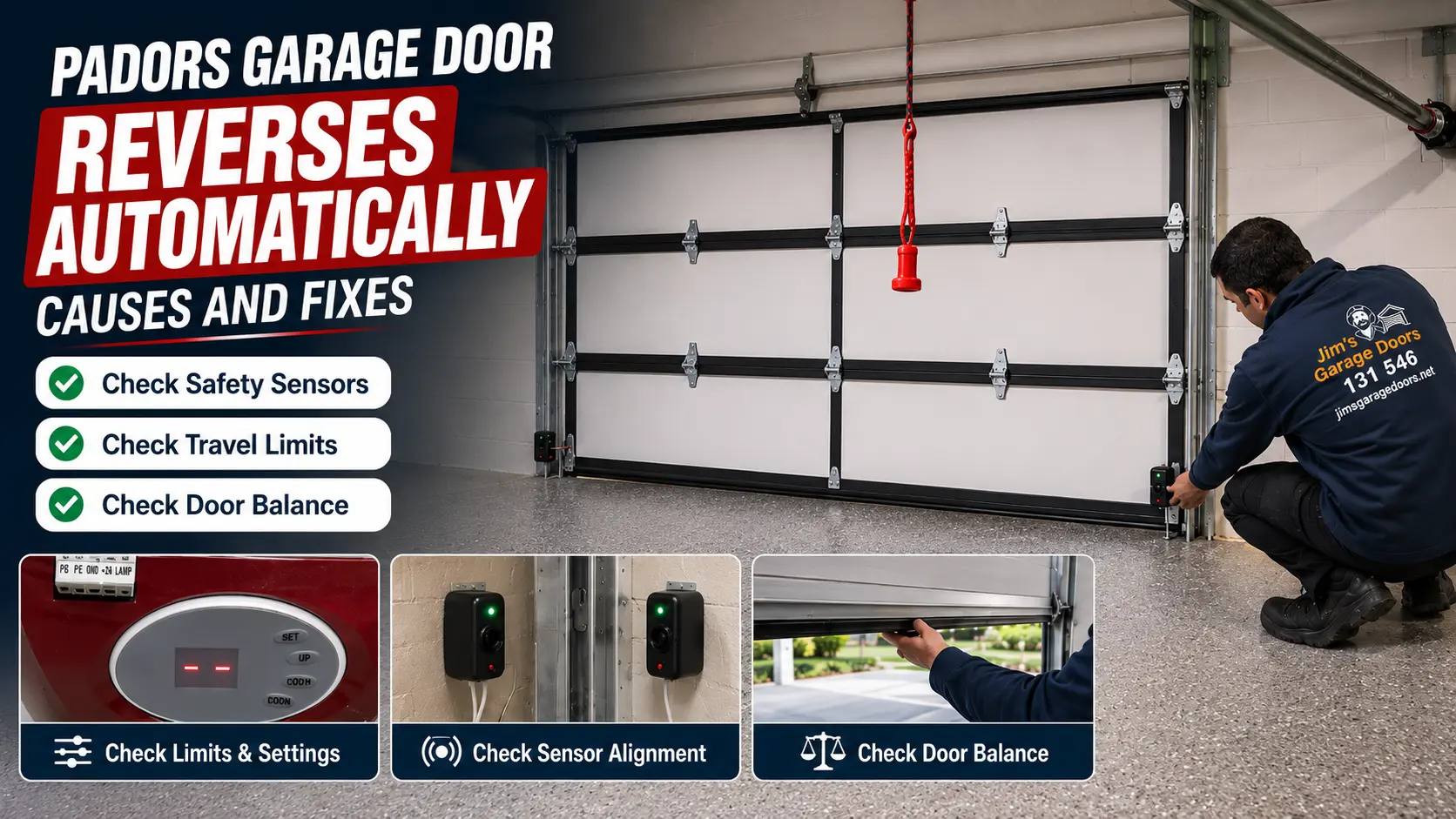
Quick Summary
- Remove objects from the doorway.
- Clean and inspect any fitted safety sensors.
- Note where the door reverses.
- Check whether it contacts the floor first.
- Test manual movement only when the door is fully closed and stable.
- Do not increase the force setting before finding the cause.
- Book an inspection if the limits will not save or the door remains unreliable.
Why Does a Padors Garage Door Reverse Automatically?
Automatic reversal is a safety response. The opener may reverse when it detects an obstruction, excessive resistance or an unexpected travel position.
Common causes include:
- An object in the doorway
- Dirty or misaligned safety sensors
- A closing travel limit set too far
- Stiff rollers or damaged tracks
- A heavy or unbalanced door
- Broken or weakened springs
- Loose or uneven cables
- Excessive bottom-seal compression
- Incorrect force settings
- A position-sensing or opener-control fault
The correct repair is to identify why the opener is reacting, not to disable or overpower the reversal function.
What Does the Reversal Point Tell You?
| Door behaviour | Likely causes | Best next step |
|---|---|---|
| Door reaches the floor and reverses | Closing limit set too far, floor contact or compressed bottom seal | Check the bottom edge and have the closing limit tested |
| Door reverses halfway down | Track obstruction, stiff roller, spring imbalance, cable issue or sensor fault | Inspect the same section and test manual movement safely |
| Door reverses immediately | Safety-beam obstruction, alignment issue, wiring fault or control input problem | Clean and inspect the sensors |
| Door reverses at the same height | Local track damage, panel binding, roller resistance or programmed travel issue | Inspect that area of the door and track |
| Door reverses at different positions | Intermittent sensor, wiring, electrical or control fault | Book a complete inspection |
| Door hits the floor hard before reversing | Closing limit set too far, excessive force or control fault | Stop repeated operation and arrange diagnosis |
| Door feels heavy manually | Spring, cable or balance problem | Stop using the opener and book a door repair |
What Should You Check First?
Start with visible, low-risk checks. Do not open the motor housing or alter internal wiring.
1. Clear the Doorway
Remove tools, boxes, leaves and other objects from the opening.
Check the bottom weather seal for folded rubber, stones or debris that may increase resistance when the door reaches the floor.
If the door reverses after you’ve recently paired a new transmitter, verify that the opener is programmed correctly before adjusting the travel limits.
2. Check the Safety Sensors
Where safety beams are fitted:
- Wipe the lenses with a clean, dry cloth.
- Remove objects between the sensors.
- Check that both units are firmly mounted.
- Look for loose or damaged wiring.
- Confirm that the brackets have not been knocked out of position.
A sensor may look aligned but still lose its signal because of vibration, damaged wiring or a loose mounting bracket.
3. Observe One Closing Cycle
Stand clear and watch one controlled closing cycle.
Record:
- Where the reversal occurs
- Whether the motor light flashes
- Whether the display shows an unusual message
- Whether the motor strains or changes sound
- Whether the door touches the floor first
- Whether the fault occurs at the same point every time
These details help separate a mechanical problem from an opener fault.
How Do You Test the Door Balance Safely?
Only test manual movement when the door is fully closed, level and showing no obvious spring or cable damage.
Do not pull the manual release while the door is open or partly open. A door with a failed spring or cable may fall or move suddenly.
Safe Manual Test
- Close the garage door fully.
- Check that the door is level.
- Look for loose cables, broken springs or damaged tracks.
- Pull the manual release only if the door appears stable.
- Lift the door slowly by hand.
- Stop if it feels very heavy, catches, tilts or cannot be controlled.
A balanced door should move with controlled effort and should not drop suddenly.
If the door catches manually, the opener may be reversing because it detects genuine resistance from the tracks, rollers, hinges, cables, springs or door alignment.
If the door moves smoothly by hand but reverses under motor power, the opener settings, sensors, drive system or controls require further testing.
Could the Closing Limit Be Set Too Far?
Yes. If the closing limit extends beyond the actual floor position, the opener may keep applying force after the door has closed. It may then detect the resistance and reverse.
Typical signs include:
- The door reaches the floor before reversing
- The bottom seal compresses heavily
- The bottom panel pushes downward
- The motor sound changes at floor contact
- The same fault occurs during every closing cycle
Travel settings should only be adjusted using instructions for the exact Padors model.
If the correct setting cannot be stored or the opener repeatedly loses its travel position, the control system may require professional inspection.
Could the Force Setting Be Causing the Problem?
Yes. The opener may reverse when the force required to move the door exceeds its programmed threshold.
This may be caused by:
- A force setting that is too sensitive
- A heavier or unbalanced door
- Binding rollers or hinges
- Dirty or damaged tracks
- Weak or broken springs
- Excessive bottom-seal resistance
- Wear inside the opener drive
Do not increase the force simply to make the door close.
Increasing force without repairing the underlying problem can reduce obstacle sensitivity and place extra strain on the opener and door hardware.
Is the Fault Mechanical or Inside the Opener?
| Test result | More likely issue | Recommended action |
|---|---|---|
| Door catches or feels heavy manually | Springs, cables, rollers, tracks or balance | Book a mechanical door inspection |
| Door moves smoothly manually but reverses under power | Travel setting, force setting, drive or controls | Arrange opener diagnosis |
| Door closes from the wall control but not the remote | Remote, receiver or control mode | Check remote and receiver operation |
| Door reverses only when sensors are active | Sensor alignment, obstruction or wiring | Clean and inspect the sensors |
| Door hits the floor before reversing | Closing travel set too far | Have the limit corrected |
| Display or motor light behaves abnormally | Power, panel or opener-control fault | Record the indication and book testing |
| Reversal occurs unpredictably | Intermittent sensor, wiring, electrical or control fault | Arrange a full inspection |
What Do People Commonly Get Wrong?
1. Increasing the Force Too Early
A higher force setting may push the door through resistance, but it does not repair damaged tracks, poor balance, stiff rollers or faulty sensors.
2. Assuming Every Reversal Is Electronic
Many reversal problems begin with mechanical resistance, incorrect travel settings or a safety-beam issue.
3. Pulling the Manual Release While the Door Is Open
This can be dangerous if a spring or cable has failed. Manual testing should only be completed with the door fully closed and stable.
4. Ignoring a Heavy or Crooked Door
A tilted or heavy door may have a spring, cable, roller or track problem. Continued use can cause further damage.
5. Replacing the Motor Before Checking the Door
A new opener will not correct bent tracks, broken springs, damaged cables or poor door balance.
Which Checks Are Safe to Do Yourself?
| Check | Homeowner action | Technician required |
|---|---|---|
| Remove objects from the doorway | Safe | Usually no |
| Clean sensor lenses | Safe | If the fault continues |
| Check visible sensor alignment | Safe | If alignment will not hold |
| Observe the display or motor light | Safe | If an abnormal indication persists |
| Inspect tracks for debris | Safe | If tracks are bent or damaged |
| Test manual movement with the door closed | Only if the door is level and stable | If heavy, crooked or unstable |
| Adjust travel limits | Only with verified model instructions | If settings will not save |
| Increase force | Not recommended without diagnosis | Professional testing advised |
| Open the motor housing | No | Always |
| Repair springs, cables or tracks | No | Always |
Can a Broken Spring Make the Padors Opener Reverse?
Yes. A broken or weakened spring can make the garage door much heavier, causing the opener to detect excessive resistance and reverse.
Signs of a spring problem include:
- The door feels very heavy
- The door opens only partway
- One side rises faster than the other
- The opener strains or hums
- The door will not remain partly open
- A visible gap appears in a torsion spring
Garage door springs are under high tension and should only be repaired by a qualified technician.
Should You Repair or Replace the Padors Opener?
Repair may still make sense when the door is mechanically sound and the problem is limited to settings, sensors, wiring or a serviceable control component.
Consider Repair When
- The door is balanced and moves smoothly
- The motor runs consistently
- Sensor alignment can be corrected
- Travel settings can be restored
- The required component is available
Consider Replacement When
- Travel settings will not remain stored
- The motor reverses unpredictably
- The display or controls are unreliable
- Several faults are present
- Parts are difficult or uneconomical to source
- The opener no longer operates dependably
Older Padors models may have limited availability of original control boards, switches and compatible electronic parts. Repair options depend on the exact model and the condition of the system.
When the opener only produces a humming sound instead of lifting the garage door, the issue usually points to a mechanical failure rather than the reversal system.
Need Professional Garage Door Opener Repairs?
If your Padors garage door still reverses after checking the safety sensors, door balance and travel settings, the fault may involve the opener controls, drive system or internal components.
Jim’s Garage Doors provides professional garage door opener repairs and replacements, including fault diagnosis, travel and force setting adjustments, safety sensor testing and replacement opener installation where needed, restoring safe and reliable operation.
If you’re troubleshooting a PDR-series opener, understanding the differences between PDR-105 and PDR-106 can help identify model-specific settings and replacement parts.
Frequently Asked Questions
Why does my Padors garage door hit the floor and reverse?
The closing travel limit may be set too far, causing the motor to keep pushing after the door reaches the floor. Bottom-seal compression or excessive resistance can also trigger reversal.
Why does my Padors door reverse halfway down?
The door may be meeting resistance from a roller, track, hinge, spring or cable problem. A sensor or opener-control issue is also possible.
Can dirty safety sensors make a Padors door reverse?
Yes. Dirt, misalignment, blocked beams or damaged wiring can stop the opener from completing a closing cycle.
Should I increase the force setting?
Not before checking the door balance, tracks, rollers, sensors and travel limits. Increasing force without fixing the cause may reduce obstacle sensitivity.
Can I pull the manual release to test the door?
Only when the door is fully closed, level and showing no obvious spring or cable damage.
Book a Padors Garage Door Inspection
Call Jim’s Garage Doors on 131 546 if your Padors garage door hits the floor and reverses, stops during travel, closes unpredictably or will not remain shut.
A local technician can inspect the garage door, safety sensors and opener controls before recommending repair or replacement.