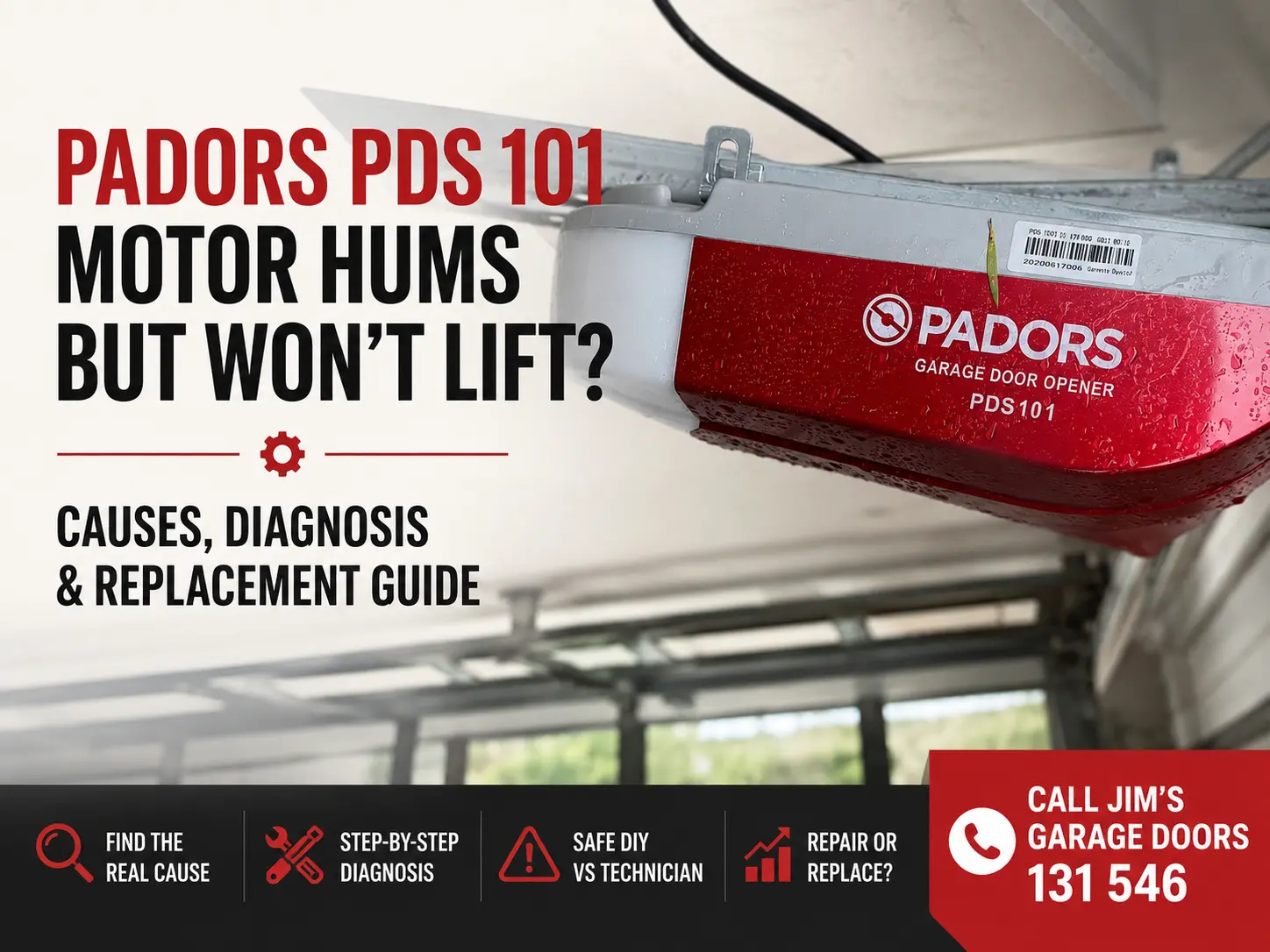
A Padors PDS 101 motor usually hums without lifting the garage door because the opener is receiving power but cannot transfer enough force to move the door. The cause may be a heavy or mechanically jammed sectional door, a broken spring, a disconnected trolley, a worn drive component or an internal opener fault.
Do not keep pressing the remote when the door is not moving. Repeated attempts can place additional load on the motor and may worsen an existing mechanical fault.
This guide explains the checks homeowners can perform safely, the warning signs that require a garage door technician, and when replacing an ageing Padors opener is more sensible than trying to rebuild it.
Padors PDS 101 Troubleshooting at a Glance
| What You Notice | Most Likely Cause | Best Next Step |
|---|---|---|
| Motor hums and the door feels extremely heavy manually | Broken, weakened or disconnected garage door spring | Stop using the opener and book a spring inspection |
| Motor runs but the chain or trolley does not move | Internal drive, sprocket, gear or rail fault | Disconnect power and arrange an opener assessment |
| Chain moves but the door remains closed | Trolley is disengaged or damaged | Inspect the emergency release without touching springs or cables |
| Door moves briefly and stops | Excessive resistance, incorrect force detection or a mechanical obstruction | Test the door manually and book a service if movement is uneven |
| Opener responds inconsistently or remains in programming mode | Control panel, receiver or electronic fault | Reset only according to the manual; otherwise request professional diagnosis |
| Door moves smoothly by hand but the opener only hums | Fault is probably within the opener or drive rail | Compare repair feasibility with modern opener replacement |
Why Does a Padors PDS 101 Hum Without Moving the Door?
The humming sound usually means the Padors opener has electrical power, but the door or drive system is preventing normal movement. It does not prove that the motor itself has failed.
A sectional garage door opener must transfer force through several connected components:
- The motor creates rotational force.
- The opener’s internal drive transfers that force to the rail mechanism.
- The chain, trolley or carriage moves along the rail.
- The connected arm pulls or pushes the garage door.
- The garage door springs counterbalance most of the door’s weight.
A failure anywhere in that sequence can leave the motor energised while the door remains stationary.
The four most likely fault groups are:
- A broken or weakened garage door spring
- A jammed, uneven or damaged sectional door
- A disengaged or broken trolley connection
- A failed internal opener or drive component
What Should You Check First?
First, stop operating the opener, inspect the door from a safe distance and check whether anything is visibly obstructing its movement. Do not remove the opener cover or adjust springs, cables, brackets or force settings during an initial check.
Check for:
- An object blocking the door opening
- A roller outside the track
- A bent or damaged track
- A loose or hanging cable
- A visible gap in a torsion spring
- A door sitting unevenly
- A trolley that is no longer connected to the door arm
- Plastic or metal debris beneath the opener
- A burning smell, heat or electrical buzzing
Disconnect power and call a technician if you see a broken spring, loose cable, damaged bracket, off-track roller or electrical damage.
If the motor runs but the door reverses during operation instead of remaining stationary, troubleshoot the reversal system separately.
Is the Fault in the Padors Opener or the Garage Door?
The safest way to separate an opener fault from a door fault is to disengage the opener and test the door manually. Only perform this test when the garage door is fully closed.
How to Perform a Manual Door Balance Check
- Close the garage door fully.
- Switch off or unplug the opener.
- Locate the emergency-release cord connected to the trolley.
- Pull the release according to the opener’s operating instructions.
- Lift the garage door slowly using its handle.
- Stop immediately if the door feels unusually heavy, rises unevenly or binds.
Do not disengage an open garage door. A door with a broken spring or cable may fall when disconnected from the opener.
What Most Homeowners Get Wrong About a Humming Motor
A humming Padors PDS 101 does not automatically mean the electric motor is dead. In many cases, the motor is trying to operate but another component is preventing its force from reaching the door.
Common incorrect assumptions include:
- Increasing the force setting will fix a heavy door
- Repeated remote presses will free the mechanism
- A broken spring is harmless because the opener can still lift
- Any humming noise means the whole motor has burned out
- A new remote will fix a drive-system fault
- Lubricating the opener rail will repair damaged internal parts
Force settings should never be increased to overcome a heavy, binding or damaged door. The source of the resistance must be corrected first.
Before replacing mechanical components, confirm that the remote control has been paired correctly with the opener.
Could a Broken Garage Door Spring Make the PDS 101 Hum?
Yes. A broken or weakened spring can make the Padors PDS 101 hum, stall, reverse or stop because the opener is being asked to lift far more weight than intended.
Look for:
- A visible gap in the torsion spring above the door
- A loud bang heard before the problem began
- A door that lifts only a few centimetres
- One side of the door rising before the other
- Loose cables near the lower corners
- A door that feels much heavier than usual
Do not touch the spring, cable drums, bottom brackets or lifting cables. These components may remain under substantial tension even when the door is closed.
Need a spring inspection? Call Jim’s Garage Doors on 131 546 before operating the door again.
Could the Emergency-Release Trolley Be Disconnected?
Yes. If the motor and rail mechanism move but the garage door does not, the opener trolley may still be disengaged from the door.
Some Padors operating instructions use separate release and re-engagement actions. Follow the instructions associated with the installed unit rather than pulling cords repeatedly or forcing the trolley.
After the door fault has been ruled out:
- Confirm the door is fully closed
- Check whether the trolley is engaged
- Inspect the door arm connection
- Look for a cracked or separated carriage
- Do not place fingers inside the rail or moving trolley
A damaged trolley or door arm should be repaired before the opener is tested again.
Could the Internal Drive or Sprocket Have Failed?
An internal drive fault is likely when the Padors motor hums or spins but the chain and trolley remain stationary. Grinding, slipping or debris beneath the motor head can support this diagnosis, but the cover should only be removed by a qualified technician.
Possible internal faults include:
- Worn drive components
- A damaged sprocket or shaft
- A failed coupling
- A seized bearing
- A jammed rail mechanism
- Electrical components that cannot start or control the motor correctly
The exact internal construction and available replacement parts should be confirmed from the installed unit and its service documentation. Do not assume that every humming PDS 101 has the same failed gear.
Replacement gears, trolleys, and drive components may differ slightly between the PDR-105 and PDR-106 models.
What Does “Su” on a Padors PDS 101 Display Mean?
“Su” is associated with the PDS 101 remote-learning process and does not, by itself, confirm a failed logic board. Published programming instructions state that “Su” appears after the code button is pressed and should change after a compatible remote is coded.
If “Su” appeared after someone pressed the code button, the opener may simply be waiting for a remote-learning input.
Professional assessment is appropriate when:
- The display remains stuck after the correct programming sequence
- The control panel does not respond normally
- The opener enters programming mode without input
- The remote codes but the motor still cannot move the door
- The display behaves erratically
- There is visible moisture or electrical damage
Avoid repeatedly pressing programming buttons when the original fault is mechanical. Remote coding cannot repair a broken spring, damaged trolley or failed drive.
Safe DIY Checks vs Technician-Only Work
| Task | Safe for a Homeowner? | Important Limit |
|---|---|---|
| Check the power outlet and opener plug | Yes | Stop if the outlet, lead or opener smells burnt |
| Remove objects from the doorway | Yes | Do not stand beneath an unsupported door |
| Inspect tracks, rollers and springs visually | Yes | Look only; do not loosen hardware |
| Disengage the opener with the door fully closed | Usually | Do not release an open or unstable door |
| Lift the door slowly to assess weight and balance | Usually | Stop if it is heavy, uneven or binding |
| Replace a compatible remote battery | Yes | This will not fix a motor or door fault |
| Program a compatible remote | Usually | Follow the exact PDS 101 instructions |
| Adjust spring tension | No | High-tension system |
| Replace cables or bottom brackets | No | High-tension system |
| Open the motor casing | No | Electrical and moving-component risk |
| Adjust force to overcome resistance | No | May defeat protective operation |
| Replace the opener or rail | No | Requires correct installation and safety testing |
Can a Padors PDS 101 Still Be Repaired?
A Padors PDS 101 may be repairable when the door fault is external to the opener or when a suitable, verified component remains available. Replacement is usually the stronger option when the motor head, electronics or proprietary drive components have failed and reliable parts support is limited.
The PDS 101 opener is listed by at least one Australian supplier as no longer available, although compatible Padors remotes and some accessories are still sold. It is therefore inaccurate to say that every Padors-related part has disappeared from the Australian market.
A technician should assess:
- The age and overall condition of the opener
- Whether the garage door itself is balanced
- The failed component
- Parts availability and compatibility
- Labour required for diagnosis and repair
- Condition of the rail, trolley and door arm
- Reliability expected after the repair
- Safety functions and reversal performance
- Warranty available on the proposed work
Should You Repair the Door or Replace the Opener?
Repair the garage door when the opener is serviceable and the fault lies in springs, rollers, hinges, tracks or cables. Replace the opener when the door is mechanically sound but the old motor head or proprietary drive system has failed and a dependable repair is not commercially sensible.
| Inspection Result | Better Option | Reason |
|---|---|---|
| Broken spring but opener operates normally after the door is balanced | Repair the spring system | The motor may not be the original cause |
| Damaged roller, hinge or track | Repair the sectional door | Mechanical resistance must be removed first |
| Trolley is disengaged but undamaged | Re-engage and test | Replacement may not be required |
| Repairable trolley or arm fault with sound opener | Repair after inspection | The fault may be limited to the connection |
| Balanced door but motor hums and drive does not move | Assess replacement | Internal opener fault is more likely |
| Failed electronic controls with poor parts support | Replace opener | Repair value and future reliability may be weak |
| Several age-related faults are present | Replace opener | Multiple repairs can exceed the value of the old system |
| Opener lacks required functions for the intended smart-control setup | Upgrade system | New controls may require additional safety equipment |
When Does Replacing the Padors Opener Make More Sense?
Replacement makes more sense when the garage door is mechanically sound but the PDS 101 has a major internal fault, uncertain parts support or several worn components.
Replacement is often the better decision when:
- The drive assembly no longer transfers movement
- The control electronics are unreliable
- The rail or trolley is also worn
- Parts cannot be verified or warranted
- Previous repairs have not restored dependable operation
- The proposed repair cost is close to a replacement system
- The homeowner wants supported remotes, accessories or smart controls
- A new opener can be installed with a clear product and workmanship warranty
This is not a rule that every old Padors unit must be replaced. A technician should first confirm that the garage door itself is safe, balanced and suitable for automation.
What Should Replace a Padors PDS 101?
The replacement should be selected for the door’s size, weight, spring balance, daily use, rail configuration and required controls—not simply because one brand is popular.
Depending on the installation, suitable options may include supported sectional-door openers from brands such as Merlin or Automatic Technology Australia.
AS/NZS 60335.2.95:2024 covers safety requirements for electric drives used with vertically moving residential garage doors. A professional installer should match the new opener and any required safety devices to the installation and intended mode of control.
Smartphone control also needs careful consideration. Industry guidance notes the relevance of monitored safety beams when compatible openers are operated through smart controls.
What Happens During a Professional Padors Replacement?
A proper replacement involves more than removing the old motor head and fitting another unit. The technician must confirm that the sectional door is safe and balanced before the new opener is commissioned.
A professional service should include:
- Inspecting springs, cables, rollers, hinges and tracks
- Testing the door manually
- Confirming the door’s weight and operating condition
- Diagnosing whether the fault is in the door, rail or opener
- Removing the old Padors system where replacement is approved
- Installing the correct opener and rail arrangement
- Setting travel limits and operating force
- Testing stop and reversal functions
- Programming remotes and optional controls
- Explaining manual release and routine safety checks
- Removing the old equipment where included in the service
Three Common Padors PDS 101 Fault Scenarios
1. The Motor Hums and the Door Is Extremely Heavy
The garage door spring system is the likely cause.
Action: Stop using the opener and book a spring inspection.
Expected result: Once the spring system is repaired and the door is balanced, the technician can test whether the PDS 101 has also sustained damage.
2. The Door Moves Smoothly by Hand but the Chain Does Not Move
An opener drive or motor-head fault is likely.
Action: Leave the opener disconnected and request a repair-versus-replacement assessment.
Expected result: The technician can determine whether a supported repair exists or whether replacement offers better long-term value.
3. The Rail Moves but the Garage Door Does Not
The trolley, release mechanism or connecting arm may be disengaged or damaged.
Action: Keep the door closed and inspect the connection without touching springs or cables.
Expected result: A sound trolley may only require correct re-engagement. A broken carriage or arm requires repair before testing.
How Can You Reduce Stress on the Replacement Opener?
The best way to protect a new opener is to keep the garage door mechanically balanced and serviced. Even a high-quality motor will wear prematurely if it must drag a heavy, binding or poorly aligned door.
Useful maintenance checks include:
- Test manual door balance periodically
- Listen for scraping, popping or grinding
- Keep tracks clean without applying grease inside them
- Use the lubricant recommended for hinges, rollers and springs
- Test safety reversal according to the opener instructions
- Keep safety beams clean and aligned
- Replace damaged rollers and hinges early
- Arrange servicing when the door becomes noisy, heavy or uneven
A garage door opener should move a correctly balanced door. It should not compensate for failing springs or damaged hardware.
Frequently Asked Questions
Is it safe to keep using a Padors PDS 101 that only hums?
No. Stop using it until the cause has been identified. Continued attempts can add strain to the motor and may be dangerous if the door has a broken spring, cable fault or unstable hardware.
Can I lift the garage door manually?
Usually, but only when the door is fully closed before the opener is disengaged. Stop if the door feels heavy, rises unevenly or will not remain under control.
Does humming mean the PDS 101 motor is burnt out?
Not necessarily. Humming can occur when the motor receives power but cannot move the door because of mechanical resistance, a disconnected drive or an internal opener fault.
Can I increase the force setting to make the door open?
No. Increasing force to overcome a heavy or binding door can hide a mechanical problem and reduce safe obstruction response.
Are Padors PDS 101 remotes still available?
Compatible remotes are still listed by Australian remote-control suppliers. Availability can change, so confirm the exact remote model and compatibility before purchasing.
Does “Su” mean the logic board has failed?
No. “Su” is used during remote programming. A control fault becomes more likely only when the display does not behave correctly after the approved programming or reset procedure.
Can the old Padors rail be reused with a new motor?
Usually, a new opener should be installed with the rail and components approved for that model. Compatibility must be confirmed by the installer rather than assumed.
Is a broken spring an opener problem?
No, but it can cause opener symptoms. A broken spring makes the door too heavy and may cause the PDS 101 to hum, stop or reverse.
Should I repair or replace my PDS 101?
Repair the door when springs, rollers, tracks or other door hardware are responsible. Consider replacing the opener when the door is balanced but the motor head, electronics or drive system has a major unsupported fault.
Book a Padors PDS 101 Inspection
Jim’s Garage Doors can inspect the sectional door, test its balance and determine whether the Padors PDS 101, trolley, spring system or other hardware is causing the failure.
Our local, police-checked and fully insured technicians can:
- Diagnose the source of the humming or stalled operation
- Inspect springs, cables, rollers, tracks and hinges
- Test the garage door independently from the opener
- Explain whether repair or replacement offers better value
- Remove an unsuitable old opener
- Install a supported sectional-door opener
- Set limits, test safety operation and program controls
Do not keep operating a humming opener or attempt to work on springs, cables or internal electrical components.
Call Jim’s Garage Doors on 131 546 or request a quote online.
Padors Opener Repairs and Modern Replacement Options
A humming Padors PDS 101 may be caused by the sectional door, spring system, trolley, drive rail or opener motor head.
Jim’s Garage Doors can test the complete automatic garage door system before recommending a repair or a supported replacement.
Learn more about our garage door opener repairs and replacement services for faulty, noisy and obsolete opener systems.