
A Merlin garage door that will not close or keeps reversing is usually reacting to an obstruction, mispositioned Safety IR Beams if fitted, excessive resistance in the door, or an incorrect closing limit. Clear the doorway and clean the beam lenses first. Stop using the door if it is crooked, unusually heavy, off-track, or has damaged springs or cables.
If the door reverses immediately, check the safety beam area first. If it reverses at the same point during travel, the door may be binding. If it touches the floor and reopens, the closing limit or bottom seal may need attention.
A blocked or mispositioned Safety IR Beam may stop the door from closing if the system has beams fitted. Merlin states that its Safety IR Beams prevent the door from closing when the beam is blocked or broken.
Do not keep pressing the remote when the door reverses. The opener may be responding correctly to a safety condition, and repeated attempts can place extra load on the motor or worsen a mechanical fault.
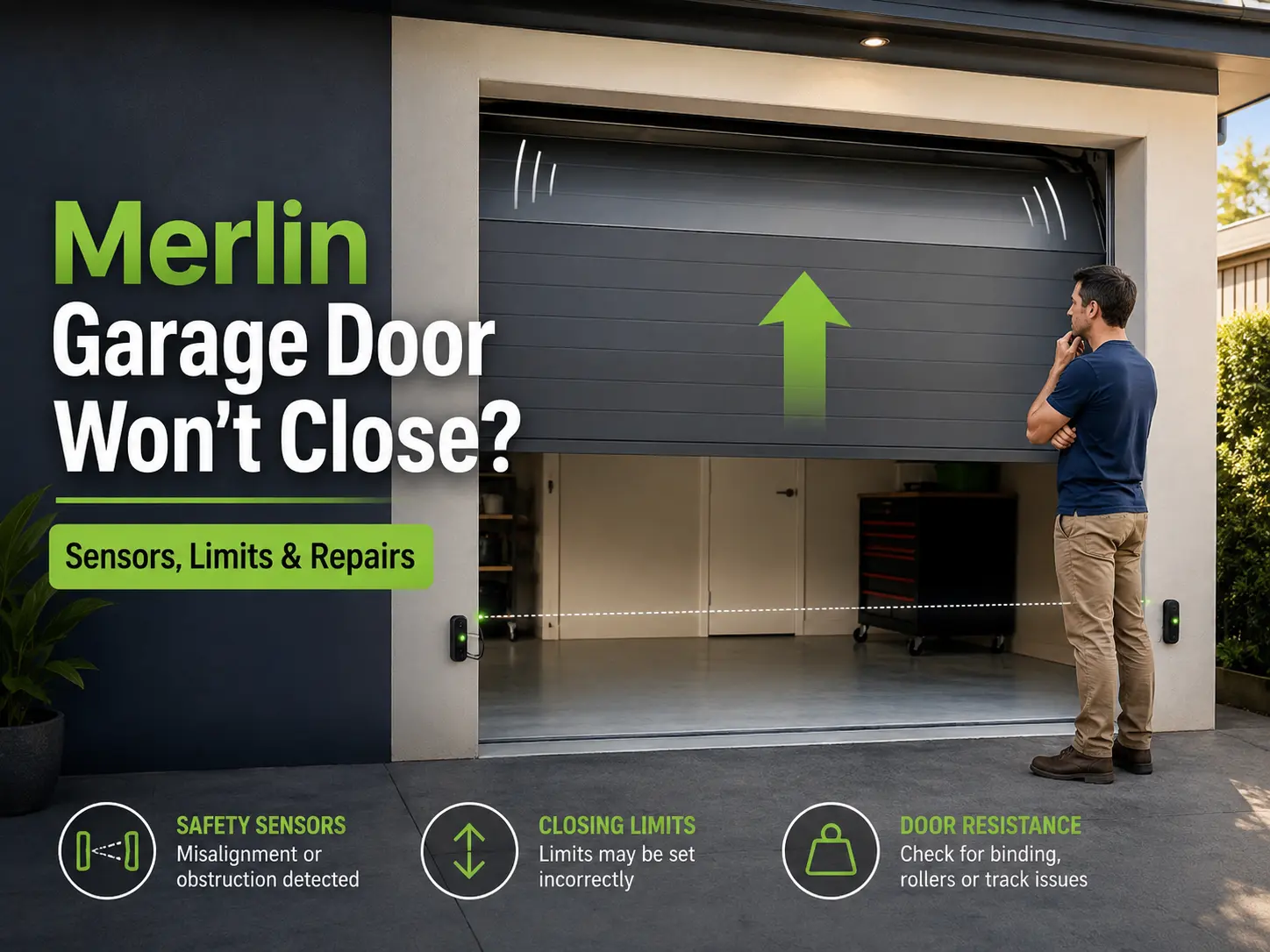
What Should You Check First?
Check the doorway, Safety IR Beams if fitted, and the way the door moves before changing any opener settings. The point where the door stops or reverses often identifies the fault group.
| What the Merlin Door Does | More Likely Cause | First Action |
|---|---|---|
| Starts closing, then immediately reverses | Blocked, dirty or mispositioned Safety IR Beams | Clear the beam area and clean the lenses |
| Reverses at the same point during travel | Binding roller, hinge, track, panel or roller-door curtain | Watch both sides of the door at the reversal point |
| Touches the floor, then reopens | Closing limit set too far, folded bottom seal or floor resistance | Check the seal, threshold and final closed position |
| Stops before reaching the floor | Beam issue, obstruction, door resistance or closing-limit fault | Check the beams and observe the door movement |
| Moves freely by hand but will not close under motor power | Safety beam, closing limit, wiring or opener-control fault | Check the beams if fitted, then arrange opener testing if the fault remains |
| Moves crookedly, feels heavy or makes harsh noises | Spring, cable, roller or track fault | Stop using the door and book an inspection |
Why Does a Merlin Garage Door Reverse While Closing?
A Merlin opener reverses when its safety system detects an obstruction or more resistance than expected. Safety IR Beams, when fitted, can also prevent the door from closing if the beam between the sensors is interrupted.
The fault usually falls into one of three groups:
- Safety detection: An object, person, vehicle or beam issue interrupts the closing cycle.
- Mechanical resistance: A roller, track, hinge, spring, cable or door panel prevents smooth movement.
- Incorrect travel setting: The opener tries to move the door beyond its correct closed position.
Watch when the reversal happens:
- Immediate reversal: Check the beam area first.
- Reversal at the same point: Inspect for binding or uneven movement.
- Reversal after touching an object: The safety system may be operating correctly.
- Reversal after touching the floor: Check the bottom seal, floor threshold and closing limit.
Step 1: Clear the Full Garage Doorway
Remove anything that could obstruct the door or interrupt the safety beam. Check the sides and corners of the opening, not only the centre of the garage floor.
Look for:
- Bins, boxes, tools or bicycles near the tracks
- Leaves, stones or dirt near the bottom corners
- A vehicle tow bar, roof rack or open boot in the door’s travel area
- A floor mat or damaged bottom seal folding beneath the door
- Items stored close to a roller-door curtain
- Spider webs, dust or insects around the beam lenses
- An object leaning against a sensor bracket
Operate the door once after clearing the area. If it closes normally, the opener was probably responding to an obstruction.
If it reverses at the same point again, watch the rollers, tracks, hinges and door panels as they pass that position.
Step 2: Check the Merlin Safety IR Beams if Fitted
Safety IR Beams are small sensor units positioned near the bottom of each side of the garage-door opening. They send an invisible beam across the doorway and prevent closing when that beam is blocked or broken.
Complete these checks:
- Wipe each lens with a clean, soft cloth.
- Remove boxes, tools, cobwebs and other objects between the sensors.
- Check whether either bracket has been bumped, twisted or loosened.
- Confirm that the sensors still face each other across the opening.
- Inspect visible low-voltage wiring for crushing, cuts or loose connections.
- Check whether the indicator lights are steady, off or flashing.
Compare the exact indicator behaviour with the manual for your Merlin opener and beam model. Do not use an LED explanation written for another Merlin model.
Is the Merlin Opener Also Flashing?
If the garage door reverses while the opener is also flashing, use our Merlin garage door opener flashing lights guide to interpret the warning alongside the closing fault. Flashing during a failed closing cycle may help separate a Safety IR Beam issue from resistance, travel or opener-related problems.
What If the Beams Look Clear but the Door Still Reverses?
A sensor can appear clean but remain out of position, have damaged wiring or fail internally. Mechanical resistance can also cause a reversal before the door touches the floor or another object.
Use the following distinction:
- If the door reverses before touching the floor or an object, check the Safety IR Beams if fitted.
- If the beams are clear, watch for binding, uneven movement or resistance at the point where the door reverses.
- If the door touches an object and reverses, the safety reversal system may be operating correctly.
- If the door touches the floor and immediately reopens, check the bottom seal, floor threshold and closing limit.
Do not cover, bypass or disconnect the beams to force the door closed.
Step 3: Check Whether the Door Is Binding
A Merlin opener may reverse because the door requires more force than expected during closing. This can happen when a roller, hinge, track, panel or roller-door curtain catches during travel.
Stand inside the garage and watch both sides of the door during one controlled closing attempt.
Look for:
- One side moving lower than the other
- A roller catching at a track joint
- A roller leaving or pressing against the track
- A sectional panel binding near the curved section
- A hinge moving unevenly
- A roller-door curtain rubbing against one guide
- A track that appears bent or displaced
- Scraping, grinding, shaking or sharp impact noises
If the door reverses at the same position every time, inspect the hardware around that position.
Do not loosen tracks, springs, cables or hinges under load. These parts support and control the weight of the door.
Step 4: Check for Spring or Cable Problems
A spring or cable fault can change the balance of the garage door and make it too heavy or uneven for the opener to control.
Stop operating the door if you notice:
- A visible gap in a torsion spring
- A loose, frayed or hanging cable
- One side of the door lower than the other
- The door dropping during movement
- A loud bang before the fault began
- The motor straining or stopping under load
- The door feeling much heavier than normal
A garage-door opener is designed to move a properly balanced door. It should not be used to pull a door with damaged springs, cables or tracks.
Can You Test the Door by Hand?
Test the door manually only when it is fully closed, stable and free from visible spring, cable or track damage. Do not use the manual release while the door is open, crooked, jammed or unusually heavy.
If the door appears safe to test:
- Close it fully.
- Switch off the opener.
- Pull the red manual-release handle according to the Merlin instructions.
- Lift the door slowly using its handle.
- Stop if it feels heavy, moves unevenly, jams or drops.
Do not pull the door using the release cord.
The door should move smoothly and remain under control. If it feels unusually heavy or will not move evenly, reconnect the opener only when the door is closed and arrange an inspection.
Step 5: Check the Bottom Seal and Floor Threshold
If the door reaches the floor and immediately reopens, it may be meeting resistance at the final closed position.
Check whether:
- The bottom seal folds sharply beneath the door
- The seal is damaged, loose or swollen
- A new floor coating has raised the surface
- A threshold strip has been added or moved
- Stones or debris sit beneath the seal
- The door presses hard against the floor before reversing
- The fault began after opener programming or door repairs
A correctly set closed position should seal the opening without forcing the door heavily into the floor.
Should You Reset the Merlin Closing Limit?
Reset the closing limit only when the door moves smoothly, the opening is clear, and the Safety IR Beams are working correctly if fitted. Use the instructions for the exact Merlin model because the programming process differs between openers.
The model number is usually printed on the side, back or underside of the motor unit. Find the correct manual before pressing programming buttons.
Do not reset the limits when:
- The door is crooked or heavy
- A spring or cable appears damaged
- The door binds during travel
- A roller has left the track
- The safety beams are not working correctly
- The opener controls do not match the manual
- The model number cannot be identified
Book a technician if:
- The limits will not save
- The learning cycle stops or reverses
- The door hits the floor hard
- The door stops well above the floor
- The settings are lost again
- The opener cannot complete the learning cycle
Do not increase the force setting to push a resistant door closed. Extra force can conceal the fault and place more strain on the opener and door hardware.
What If the Merlin Garage Door Will Not Open Either?
If the garage door now fails in both directions, the problem may involve the opener, controls, springs, cables, tracks or door balance rather than a closing fault alone. Use our Merlin garage door not opening guide to troubleshoot the wider Merlin opener and garage-door system.
Can a Power Cycle Fix a Merlin Closing Fault?
A single power cycle may clear a temporary electronic fault, but it will not fix blocked beams, damaged wiring, incorrect limits or a binding door. Try it once only after completing the visual and safety checks.
To power cycle the opener:
- Switch it off at the power point.
- Wait about one minute.
- Restore power.
- Run one controlled test.
If the same reversal returns, the cause still needs to be diagnosed. Do not continue restarting the unit.
How Do You Confirm the Door Is Closing Safely?
After the door closes normally, place a 40 mm high solid object beneath the door and run one closing cycle. The door should reverse after contacting the object; stop using the opener and arrange an inspection if it does not.
Merlin states that the door should reverse in less than one second, or within two seconds where Safety IR Beams are installed.
This test checks contact reversal. It does not replace inspection of the beam system, springs, cables, tracks or door balance.
Does the Door Close Locally but Not Through myQ?
If the garage door closes normally from the wall control or handheld remote but the myQ app shows Offline or will not complete a remote closing command, the problem may be with the connected system rather than the door mechanism. Follow our Merlin myQ not connecting or showing offline guide for Wi-Fi, gateway, account and opener-connection checks.
Stop DIY Checks Immediately When You See These Signs
Stop using the opener and arrange a garage-door inspection when:
-
- The door is crooked or off-track
- A spring is broken or has a visible gap
- A cable is loose, frayed or hanging
- The door drops or cannot be controlled
- One side moves faster than the other
- A roller has left the track
- The opener makes grinding or sharp impact noises
- The motor strains against a door that barely moves
- The door fails the 40 mm safety reversal test
techni
Do not remove springs, cables, bottom brackets or loaded track parts.
If the Merlin motor can be heard running or humming but the garage door has stopped moving altogether, the fault has moved beyond a normal closing-cycle problem. Use our Merlin motor runs but door won’t move guide to check the manual release, drive connection, springs, cables, tracks and door balance.
What Does a Technician Check?
A technician assesses both the garage door and the Merlin opener rather than assuming the motor is the cause.
The inspection may include:
- Safety IR Beam position and wiring
- Roller and track movement
- Hinges and sectional-door panels
- Roller-door guides and curtain movement
- Spring condition and door balance
- Cable condition and alignment
- Manual-release operation
- Closing limits and learning cycle
- Contact reversal response
- Opener motor and control operation
Testing the full system helps separate a door fault from a sensor, setting or opener fault.
Stop operating it. Spring, cable and track faults require onsite inspection. Call Jim’s Garage Doors on 131 546 or request a quote.
Frequently Asked Questions
Why does my Merlin garage door start closing and then go back up?
The opener may have detected a blocked Safety IR Beam, an obstruction or resistance in the door. Check the beam area if sensors are fitted, then watch whether the door reverses at the same point during travel.
Why does my Merlin garage door touch the floor and reopen?
The closing limit may be set too far, or the bottom seal and floor threshold may be creating resistance. Check for debris, a folded seal or a changed floor height before adjusting opener settings.
Can I close a Merlin garage door with faulty sensors?
Do not bypass or disconnect the sensors. Clear the beam area, clean the lenses and check the brackets. Arrange testing if the door still will not close.
Why does my Merlin garage door stop a few centimetres above the floor?
A beam fault, obstruction, binding door part or incorrect closing limit can stop the closing cycle. Check the beams if fitted and observe whether the door catches or slows near the bottom.
Should I increase the force setting when the door keeps reversing?
No. Extra force can conceal a sensor or mechanical fault. Check the doorway, beam system and door movement before changing opener settings.